Games for Learning English with Your Child: Ideas with and without Gadgets
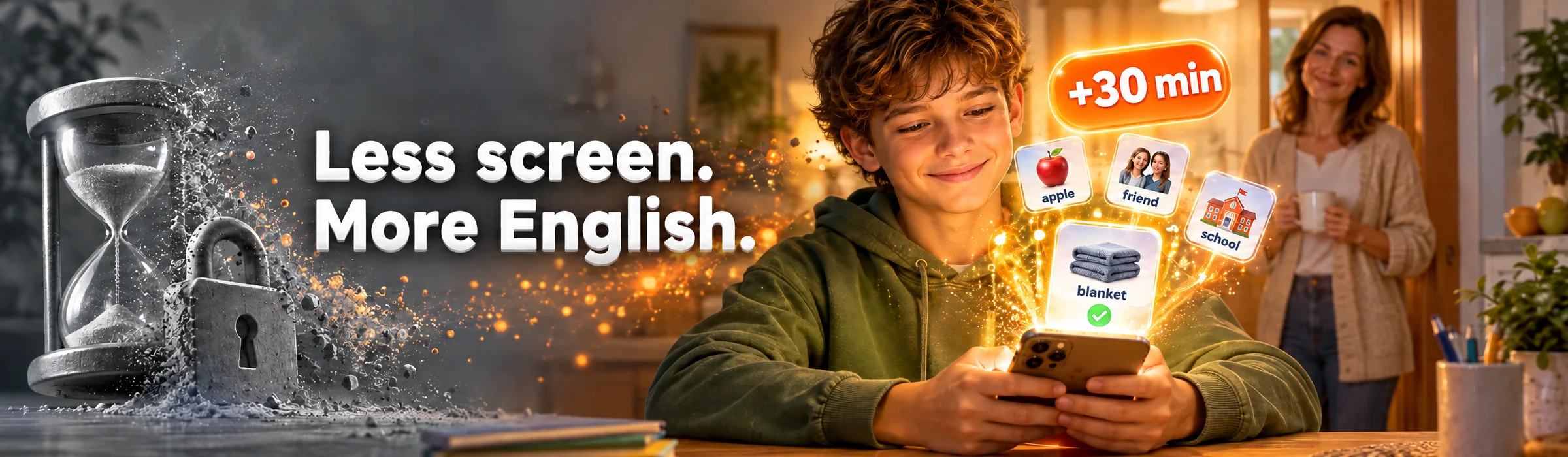
The best games for learning English with a younger schoolchild are simple: Simon Says, I Spy, memory cards, and bingo, and for Minecraft or Roblox fans — the same game in English. It all works on one principle: first a short lesson, then a game. In Mova, the phone keeps that order on its own: games on the child's iPhone open only after the English lesson.

Roman Shkabko · 10 min read
10 games without gadgets: rules in 2–3 sentences
Most of them need only cards — sets from the selection of English words by topic will do.
1. Simon Says
Age: 5–9. Practices: action verbs, body parts, listening. The leader gives commands: “Simon says touch your nose.” You only follow commands that include “Simon says”; whoever makes a mistake is out or becomes the leader.
2. I Spy
Age: 5–10. Practices: everyday vocabulary, letters, colors. The leader picks an object in the room: “I spy with my little eye something red” or “…something beginning with B.” Everyone else guesses: “Is it a book?” — “Yes, it is! / No, it isn't”.
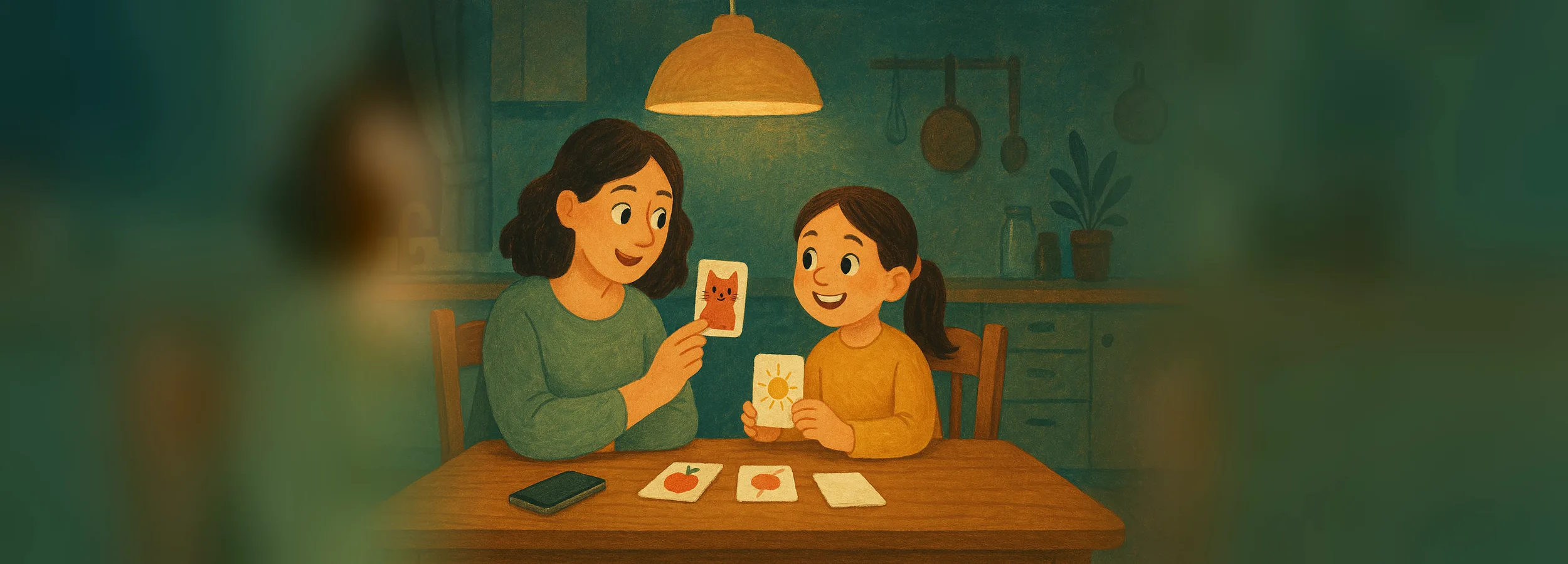
3. Memory cards
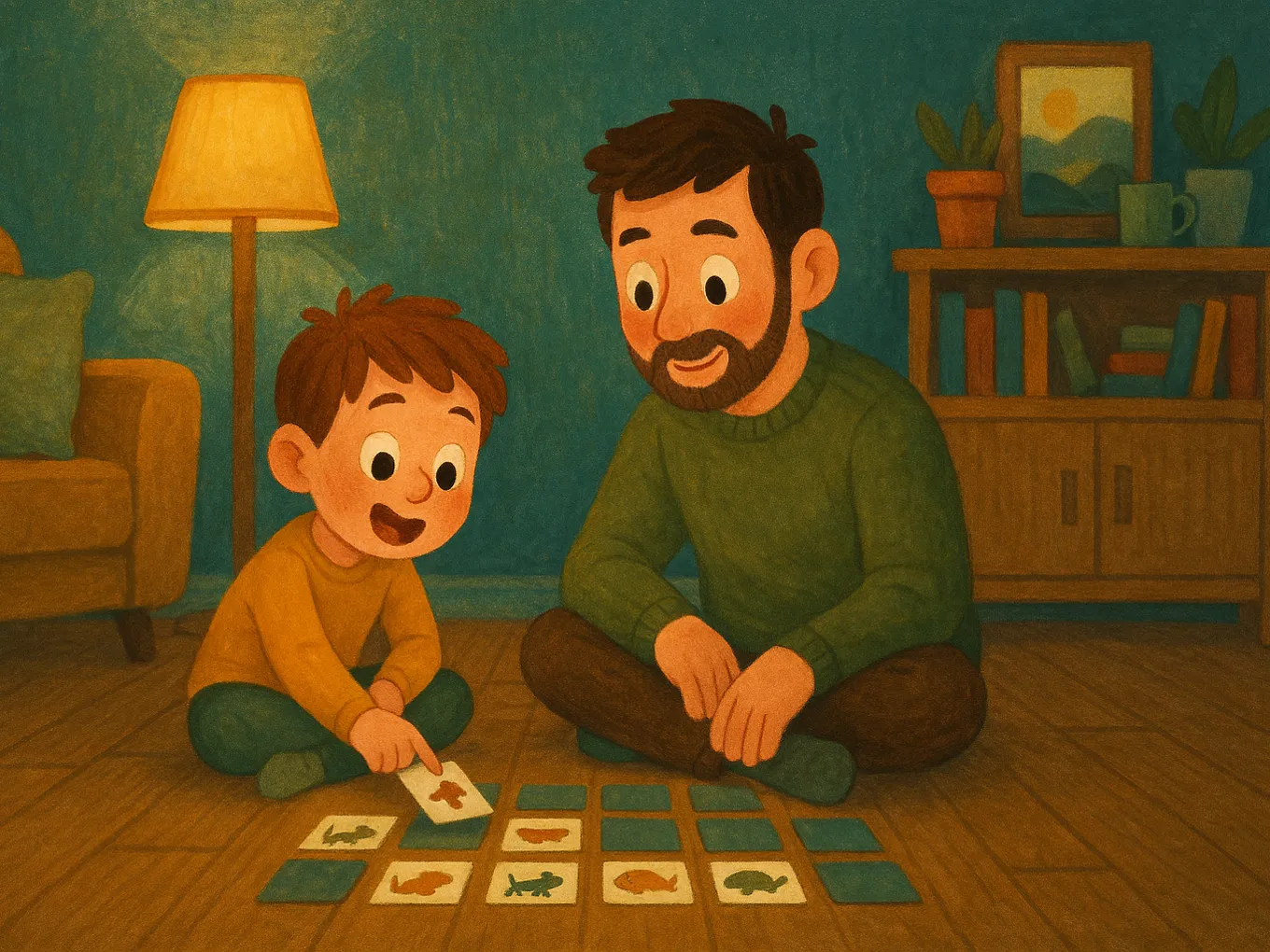
Age: 5–10. Practices: topic vocabulary, memory. Matching cards (word + picture) are laid face down. The player turns over two and names them in English; if they match, they keep the pair.
4. Bingo
Age: 6–10. Practices: listening comprehension, numbers, the week's topic. Everyone has a 3×3 card with words, and the leader calls out words at random. Whoever fills a row first shouts “Bingo!”.
5. Hot Seat
Age: 8–12. Practices: speaking. The player sits with their back to a sheet with a word on it, while everyone else explains it in English without saying it: “You sleep on it,” until they guess “a bed.”
6. Kids' Scrabble
Age: 8–12. Practices: spelling, reading. Build words from letters using a list of learned words in front of you. A no-board version: whoever makes the most words from their letters in 3 minutes wins.
7. “The Translator at the Store”
Age: 6–11. Practices: everyday phrases, numbers, politeness. You are the shop assistant who understands only English; the child “buys” things: “Can I have two apples, please? How much is it?” Use groceries from the kitchen and toy money as props.
8. Charades
Age: 6–12. Practices: verbs, animals, professions. The player silently acts out a word from a card, and the others guess in English: “Are you swimming? Is it a monkey?”
9. English Telephone
Age: 6–10, 3+ players. Practices: pronunciation and listening. A word or short phrase is whispered around the circle, and the last player says what they heard — then everyone compares it with the original.
10. Twenty Questions
Age: 9–12. Practices: yes/no questions, logic. The leader thinks of an object or animal; everyone else gets 20 questions, answered only with “Yes” or “No”: “Is it alive? Can it fly?” The best game for word order in questions.
For 5–6-year-olds, start with the first three games and rounds of 5–10 minutes — more about this age is in the article about English for preschoolers.
English for kids: online games and games on the phone
Online word games — quizzes, matching games, anagrams — add English without a tutor. Check three things: whether there is audio (without it, a child who doesn't read can't really use the game), whether there are ads (if so, play together), and whether the words come back again later. Most games show a word once and then forget it — and the child forgets it too.
Repetition is usually managed manually with cards and dates, but after a week nobody keeps up with that schedule. In Mova, it runs automatically: every word your child learns comes back after 1, 3, 7, 14, and 30 days, and a wrong answer comes back the next day.
| Games without gadgets | Online word games | Mova | |
|---|---|---|---|
| What it gives | Words in action, speaking, excitement | Vocabulary and spelling in quick rounds | A daily lesson: text, 6 words, a rule, a quiz |
| Repetition | Whenever you remember | Usually none | After 1, 3, 7, 14, 30 days |
| Level | You choose | Topic selected manually | Adapts on its own, no placement test |
| Adult needed | Yes | For younger children — yes | No |
| Screen time | — | One more screen | Games open after the lesson |
Computer games for learning English: how Minecraft and Roblox become a lesson
A favorite game gives more practice than a “learning” one:
- English interface. “Iron pickaxe” and “inventory” are remembered dozens of times in one session without cramming.
- English-speaking servers. In Roblox, most popular games are in English by default; Minecraft has international servers with chat — from age 9–10 and under supervision.
- Game videos — in the original language. The urge to figure out “how to pass it” is stronger than a textbook. The same goes for cartoons in English by level A1–B1.
- Two questions after the session: “What did you build? What happened?”
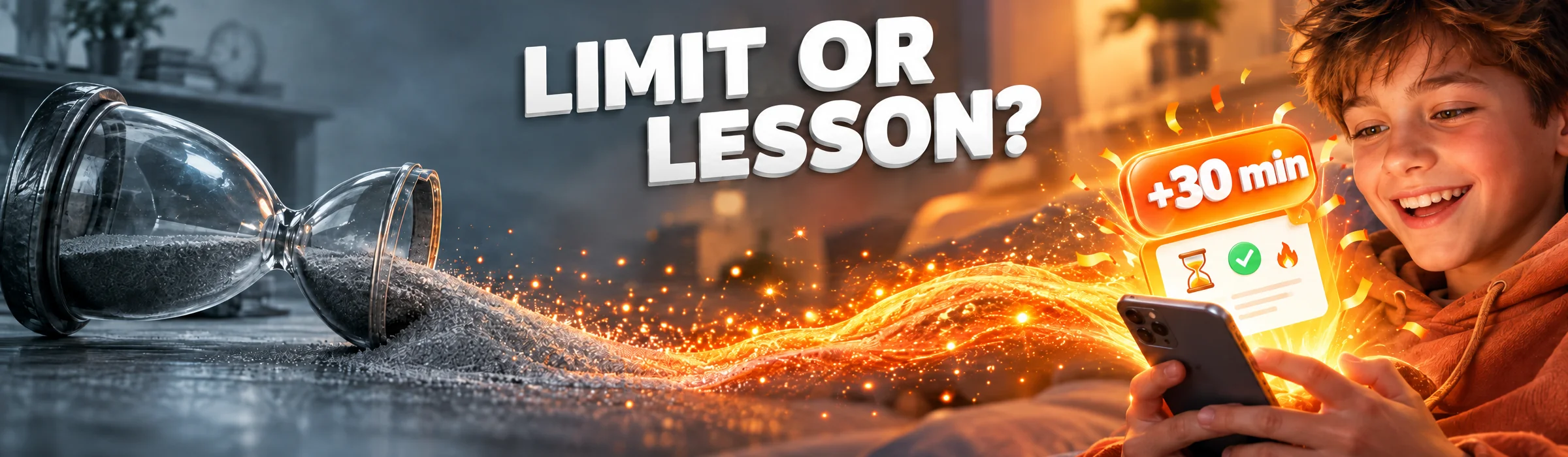
An English interface doesn't replace limits — for how to limit game time, see the article Roblox, Brawl Stars, Minecraft: how to limit game time. But a limit in settings only turns the game off by the clock, and for the game to become a reward for English, someone has to connect the two every day. So the easiest solution is to put Mova on the child's iPhone: games, social media, and videos are locked, and the minutes for Minecraft are earned through an English lesson. There is no one to argue with about “just 10 more minutes”: neither the child nor you can add minutes manually in Mova, even if you'd really like to give in in the evening. Minutes can only be earned.
Child's age → 3 best games
| Age | 3 best games | Why these |
|---|---|---|
| 5–6 years | Simon Says; memory cards; I Spy | No reading: listening, pictures, movement. |
| 7–8 years | Bingo; “the translator at the store”; charades | Reads short words — we add dialogues. |
| 9–10 years | Hot Seat; kids' Scrabble; Minecraft in English | Speaking, spelling, daily contact with the language. |
| 11–12 years | Twenty Questions; Roblox + videos in English; charades with longer phrases | Question forms and real-life language. |
The “game as a reward” principle: first the lesson, then the game
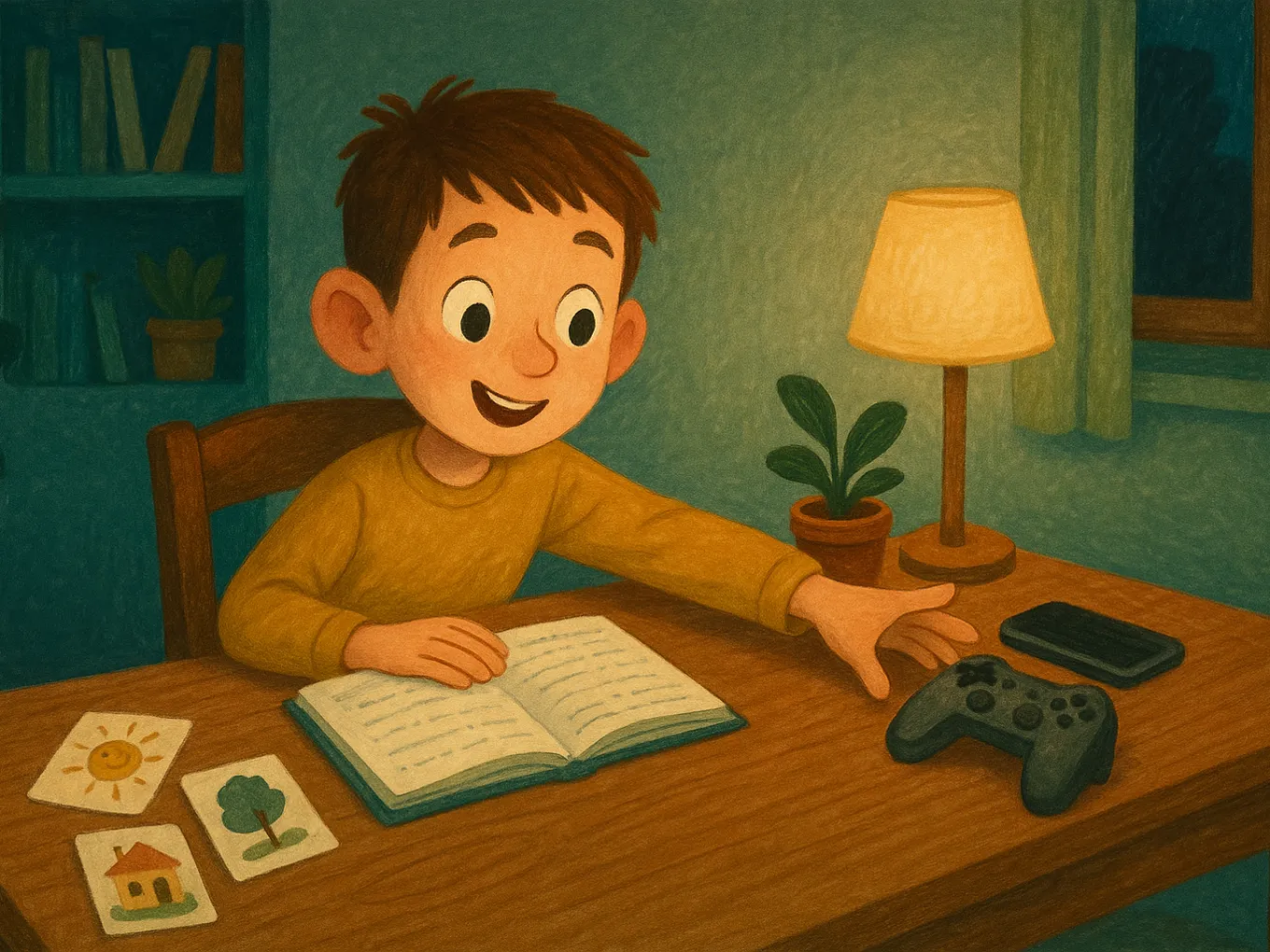
The game reinforces, while the lesson gives the words and grammar. So the order is “lesson → game”:
- The lesson comes first. A few new words, a rule, a task. Until it's done, no tablet or console.
- The game comes right after. Memory or bingo with the words just learned.
- Screen game as an earned reward. Finish the lesson — get your 30 minutes of Minecraft.
- Repetition on schedule: after 1, 3, 7, 14, and 30 days.
On paper, the system is simple, but in practice it lasts about a week: someone has to check the lesson every day, count the minutes, open and close the game, and remember which words to repeat. That's why Mova is the most reliable way to keep this order: the lesson is daily, minutes are added automatically, the game opens only when earned, and you don't have to count or remind anyone. If the quiz isn't passed, a second attempt opens an hour later with different questions, so instead of frustration, the child has a clear next step.
Not sure how to teach if you don't know English yourself — we explained how to run lessons without knowing the language in a separate article, and the “where to start” plan is in the English for Kids guide.
Mova: screen time as a reward for the lesson
Mova brings this principle into the phone: games, social media, and videos on the child's iPhone are blocked through Apple's built-in system and open for the minutes earned through an English lesson.
- Lesson → game without arguments. A “Super” quiz gives 30 minutes, “Good” gives 20, and if all tests for the day are “Super,” that's another +10. You set the amounts.
- Words don't get lost. 6 words and one rule every day, with repetition after 1, 3, 7, 14, and 30 days; if there's a mistake, the word comes back tomorrow.
- The level adjusts itself. No placement test: the difficulty adapts to the result.
- The new game is blocked too. Category-based blocking, with the list changed only with your PIN.
- Progress is visible. In the web dashboard, you can see the day's results and how many words the child already knows.
Mova doesn't replace games without gadgets: laughing and winning fairly is your part.
Mistakes that kill the game
- Grading in the game. “Wrong, sit down” — and the child won't want to play again. A mistake in a game is just a move that didn't work out.
- Correcting every word. The child will go quiet. Correct only what actually blocks understanding.
- Forcing the game. 10 lively minutes are better than 40 boring ones — stop at the high point.
- A game instead of a lesson. Without a system, words from games don't turn into language. You don't have to build the system yourself: in Mova, for example, the daily lesson with 6 words and a rule is already set up, and the game stays for after.
- Always letting them win. An adult who loses every time isn't interesting. Excitement is motivation too.
Frequently asked questions
What free games for learning English are suitable for beginners?
Simon Says, I Spy, and memory cards: all you need are printed cards, and the child doesn't have to read. All three work from zero level.
Can you learn English only through games?
No. A game reinforces words and removes the fear of speaking, but grammar, reading, and repetition need short daily lessons. The working formula is first the lesson, then the game.
At what age are online English games suitable for a child?
Simple word games from 5–6 years old, together with an adult, for 10–15 minutes. Independently — from 7–8 years old, when the child can read short words. Games with chat and servers (Roblox, Minecraft online) — from 9–10 years old and with parental control.
Do computer games for learning English, like Minecraft, help?
Yes, if the child is in contact with the language: English interface, English-speaking servers, and game videos in the original language. With a Ukrainian interface, it's just a game.
How much time a day should a child spend playing games in English?
Games without gadgets — as long as both of you find interesting. For screen games, the usual family limits apply: an English interface does not отменить the rule. In Mova, the limit is calculated automatically: a “Super” quiz opens 30 minutes of games, “Good” opens 20, and you set the amounts.
What should I do if my child plays but doesn't remember the words?
There is no repetition in the game, and a word seen once is forgotten within a few days. You need spaced repetition: after 1, 3, 7, 14, and 30 days. Manually, this is cards with dates; in Mova, the program keeps the schedule, and a mistaken word comes back the next day.
Want the game on the phone to start after the lesson, not instead of it? Try Mova for free.
Also read: