
English for Children: A Guide for Parents (Where to Start, How Much, How)
English works best for kids with a simple age-based approach: start at 5–6 with the alphabet, first words, and sounds; at 7–9, focus on reading and supporting schoolwork; at 10–13, build vocabulary, grammar, and watch shows in the original; at 14+, aim for B1 and start preparing for the NMT. The format can be anything your family can realistically keep up for months: courses, a tutor, an online school, an app, or lessons at home. Below, you’ll find all the options with 2026 pricing, a schedule for how much to study, and the minimum program for each age.

Roman Shkabko · 15 min read
When to start: 5–6 is ideal, but later is still absolutely fine
Ages 5–6 are a convenient starting point for practical reasons: children can already focus for 15–20 minutes, happily join educational games, and their hearing is still flexible, so pronunciation and sounds come easily—without the habit of “I read it the way it’s spelled.” Before school, a language feels like play, not like a graded subject.
But there are plenty of myths around an early start, and they often make parents either panic or swing to extremes:
- “After 7 it’s already too late” — no. A child of 9–12 learns new words and grammar faster than a five-year-old because they can read, generalize, and study more systematically. A later start is offset by a faster pace.
- “The earlier the better, let’s start at 2” — at ages 2–3, without an English-speaking environment at home, the effect is minimal and the effort is huge. Before 4–5, structured lessons usually aren’t worth the investment.
- “Two languages will confuse the child” — mixing words at the beginning is normal and passes. Bilingualism does not harm speech development.
The takeaway: if your child is 5–6, it’s a great time to start. If they’re 10 or 13, that’s a great time too—the tools will just be different. The only losing strategy is waiting another year for the “right moment.”

Learning formats: 7 options with prices and honest downsides
The formats below don’t cancel each other out. What works best most often is a combination of “one main format + short daily practice at home.” Prices are approximate ranges for 2026; for a detailed budget breakdown, see the separate article how much English for a child costs: tutor vs courses vs app.
Preschool with English
Age: 3–6. Price: an English club in a regular preschool — UAH 800–2000/month; a private bilingual preschool — UAH 15,000–30,000/month including full-day care (approximate, 2026). Pros: the language comes in naturally through play, with no extra effort from parents; in a bilingual preschool, there’s real daily immersion. Cons: quality varies a lot—“English” often means two 20-minute sessions a week with a song; results are hard to measure. Best for: families already choosing a preschool anyway—then English comes as a bonus; paying extra just for English only makes sense if it’s a true bilingual format.
School
Age: 6+. Price: free in public school, included in private school tuition. Pros: a structured program and regularity without your involvement. Cons: 25–30 children in a class means 1–2 minutes of speaking time per lesson; the level depends entirely on the teacher; the typical result after 5 years of school English without extra support is “I can read with a dictionary, but I’m embarrassed to speak.” Best for: everyone, as a free foundation—but school shouldn’t be your child’s only source of English.
Group courses
Age: 5+. Price: UAH 1500–3500/month for 2 classes per week (approximate, 2026). Pros: real speaking practice in a small group, a ready-made program, an element of healthy competition, and noticeably cheaper than a tutor. Cons: the pace is set for the group—a strong child gets bored, a weaker one falls behind; plus there’s the logistics of getting there and back. Best for: sociable children 7+ who specifically need spoken English and get energy from peers.
Tutor
Age: 6+. Price: UAH 400–800/hour offline, UAH 300–600/hour online; for 2 lessons a week — UAH 3200–6400/month (approximate, 2026). Pros: an individual pace, focused work on weak spots, and the fastest progress per lesson hour. Cons: the most expensive format; the result depends entirely on the quality of the specific teacher, and you still have to find a good one; no group means less live conversation with different people. Best for: when there are gaps a group won’t fix, and in the final stretch—preparing for the NMT or international exams.
Online schools
Age: 7+. Price: UAH 350–700 per lesson, or UAH 2800–5600/month for 2 lessons a week (approximate, 2026). Pros: no commuting, an interactive platform plus a live teacher, easy scheduling, and easy teacher replacement; this is the most realistic way to learn English from scratch for families in smaller towns. Cons: a child has to manage 40–50 minutes in front of a screen in learning mode—at 5–6, almost nobody can do that well; you also need a quiet space and stable internet. Best for: school-age children 7+ from busy families and anyone who doesn’t have strong offline courses nearby.
Apps
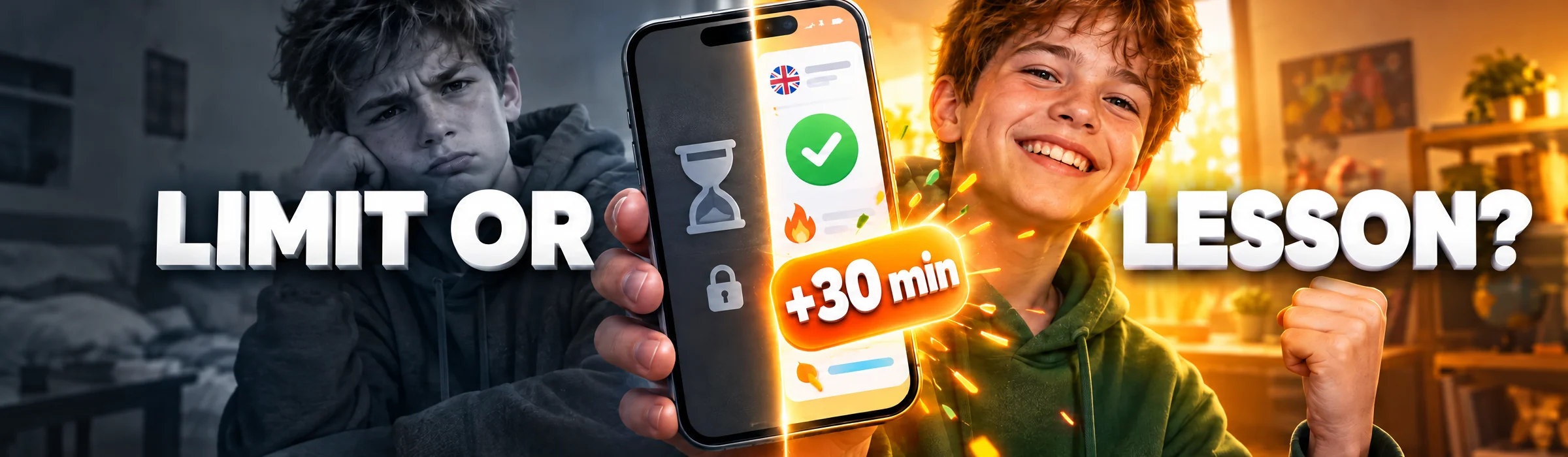
Age: 5+. Price: UAH 0–600/month (approximate, 2026). Pros: daily 10–20 minute practice, gamification, and the lowest barrier to entry in both money and effort. Cons: an app won’t fix pronunciation in real dialogue and can’t replace live conversation; the main risk is quitting after two weeks if it’s not built into a routine. Best for: everyone, as a daily trainer for vocabulary and review alongside the main format. A special case is Mova for iPhone: it doesn’t rely on willpower. Games, social media, and videos on the child’s phone are blocked, and the child earns minutes for them through a daily English lesson (a “Super” result earns 30 minutes, a “Good” result earns 20), so the lesson doesn’t get abandoned after two weeks—without it, the game won’t open. You’ll find an app comparison in the article apps for learning English for kids.
At home on your own
Age: from 5 years old. Price: UAH 0. Pros: free, flexible, and quality time with your child—at 5–6, this is actually the most natural format of all. Cons: the whole system and consistency depend on the parents; without a plan, lessons quickly slide into “we’ll do it later somehow.” The fear of “my English is just what I remember from school, I’ll ruin everything” is not a real argument: how to structure lessons without knowing the language yourself is covered in the article how to study English with your child at home if you don’t know the language. Best for: as the main foundation for preschoolers and as a must-have supplement to any paid format later on.
| Format | Age | Price, UAH/month | Main advantage | Main drawback | Best for |
|---|---|---|---|---|---|
| Preschool with English | 3–6 | 800–2000 (club); 15,000–30,000 (bilingual, all inclusive) | Immersion through play | Uneven quality, hard to verify | Families already choosing preschool anyway |
| School | 6+ | 0 | A structured free foundation | Almost no speaking practice | Everyone—but only as a foundation |
| Group courses | 5+ | 1500–3500 | Speaking practice with peers | Group pace, logistics | Sociable school-age children 7+ |
| Tutor | 6+ | 3200–6400 | Individual pace, fast progress | Most expensive, everything depends on the teacher | Gaps to close, NMT preparation |
| Online school | 7+ | 2800–5600 | No commuting, flexible schedule | Hard for children under 7 | Busy families, smaller towns |
| Apps | 5+ | 0–600 | Daily practice for next to nothing | No live conversation | Everyone—as a daily trainer |
| At home on your own | 5+ | 0 | Free and flexible | The system depends on parents | For preschoolers—the foundation; later—a supplement |
How much to study: 15 minutes every day beats 2 hours a week
The main principle that saves both money and nerves is this: frequency matters more than duration. The brain holds on to new words only when it comes back to them at short intervals—after a day, three days, a week. Two hours once a week works poorly: by the next lesson, the child has forgotten most of it, and the class starts by repeating the same material again. Fifteen minutes a day gives you those same two hours a week, but with much better retention—how spaced repetition works is explained in the article how a child can remember English words.
A practical weekly setup for any age looks like this:
- 1–2 full lessons a week — school, a course, a tutor, or an online lesson: a new topic, explanations, conversation.
- 15 minutes every day at home — reviewing words, a cartoon in English, a game, or a lesson in an app. This is not “another class,” but a short routine on the level of “brushing your teeth.”
The weak point in any agreement like this is when parents “set it up and forget it”: the first week you remind and check, the second week no one does, and the habit quietly disappears. Mova keeps that consistency for you: every day the child gets a ready-made lesson, screen-time minutes are awarded automatically, and games only unlock when they’ve been earned. Words come back using the Leitner system—exactly at the intervals mentioned above—so you don’t have to calculate or remind anyone.
The minimum program by age
Ages 5–6: the alphabet, first words, first phrases
The goal for the year is to help the child enjoy the language and build a listening foundation: the English alphabet with pronunciation, 100–200 words from everyday topics (colors, animals, food, family), and simple to be phrases by ear—I am, it is a cat—without any written grammar at all. The format should be all play: 10–15 minutes a day with songs, flashcards, and movement games. A ready-made plan for the first half-year is in the article English for preschoolers aged 5–6: where to start, and a set of activities is in games for learning English with your child. This is what healthy developmental English for kids actually looks like—no copybooks and no grades.
Ages 7–9: reading + support for school
The key task is learning to read, and this is where phonics works best: reading by sounds, not memorizing words as pictures. The method is explained in simple terms in the article how to teach a child to read in English. Alongside that: school plus 15 minutes a day at home, vocabulary grows to 300–500 words, and for grammar, to be and Present Simple are enough at the level of “I understand it and can use it in simple sentences.”
Ages 10–13: vocabulary, grammar, TV shows
This is the age when children can and should go beyond the textbook: vocabulary up to 1000+ words, systematic grammar (tenses, questions, negatives), and most importantly—contact with real language: cartoons and TV shows in English with subtitles, games, and videos in the original. What to watch for your child’s level is in the collection cartoons in English by levels A1–B1. If there was no English at all before this age, that’s not a problem: the same program can be covered faster by starting with reading and basic words.
Ages 14+: reaching B1 and preparing for the NMT
The goal is a confident B1: understanding TV shows and YouTube in the original, expressing opinions, and writing short texts. From 8th grade on, it makes sense to add regular NMT-style practice—reading and language-use tasks—a little at a time, but every week, instead of cramming in 11th grade. At this stage, a tutor or a strong group gives the best return.
How to track progress
Children’s levels are the same CEFR levels adults use—the path is just longer. Rough benchmarks: A1 — about 500 words, understands simple phrases and answers everyday questions; A2 — 1000–1500 words, can keep up a simple conversation, reads adapted texts; B1 — 2000–3000 words, watches videos in the original and can express an opinion. A normal pace is about one level every 1.5–2 years of regular study.
It makes sense to check level about once every six months—with free online tests or an assessment at school or in courses. How to do that and what results to consider normal for each grade is covered in the article a child’s English level by age and grade. Compare your child only to themselves six months ago, not to the children in the parents’ group chat.
If your child studies with Mova, the app does some of this work itself: the level adjusts based on daily results without a separate test, and in the web dashboard parents can see how many words their child already knows, how many they’re learning, and how their level is progressing.

The biggest mistakes parents make
- Waiting for the “right moment.” A year spent waiting for school, a “better preschool,” or “when they’re older” is a year in which the child could have picked up basic words for free through play.
- Rarely, but for a long time. One two-hour lesson a week loses to 15 minutes every day: everything gets forgotten between lessons, and money goes on explaining the same thing all over again.
- Turning language into an obligation. Pressure, punishment for mistakes, and “you’re not going outside until you learn it” kill motivation for years. Spoken English grows out of play and desire, not fear.
- Demanding translation. “How do you say ‘refrigerator’?” is a pointless exercise: language lives in phrases and context, not in word lists for translation.
- Changing formats every month. Quit courses after three lessons, then a new tutor a month later, then “let’s try an app.” Any format shows results after 2–3 months of consistency, not before.
- Paying and not checking. Years of paid English lessons for children without a single level check are the most expensive mistake on this list. Once every six months, look at progress and change what isn’t working.
Frequently asked questions
At what age should you start learning English with a child?
Ideally at 5–6 years old: by then, a child can already focus for 15–20 minutes, and pronunciation is easiest to shape before school. But age isn’t critical: starting at 8, 10, or 13 still works—you just use different formats, such as reading, TV shows, and systematic grammar. There’s only one worse option: putting it off for another year.
Can children learn English from scratch online?
Yes. From around age 7, the online format works fully: an online school or a tutor over video gives the program and speaking practice, while an app gives daily vocabulary review. For children aged 5–6, online lessons are harder—they’re better off starting with lessons with parents, games, and short videos.
What is developmental English for children?
These are lessons for preschoolers and younger schoolchildren where the language is introduced through play: songs, movement games, flashcards, drawing, and stories. The goal is not grammar, but the sound of the language, the first 100–300 words, and no fear of speaking. This format is offered by children’s centers, preschools with English, and at-home lessons with parents.
How much do English lessons for children cost in 2026?
Approximate 2026 prices: group courses — UAH 1500–3500/month, a tutor — UAH 300–800 per hour (UAH 3200–6400/month for two lessons a week), online schools — UAH 2800–5600/month, apps — UAH 0–600/month. Lessons at home with parents are free; all you need is time and a system.
How can a child get speaking practice if the parents don’t speak English?
Spoken English for children comes from three sources: group courses or speaking clubs, a tutor or online school, and everyday mini-dialogues at home using simple phrases that parents can learn together with the child. The parents’ level is not an obstacle: your role is not to teach, but to organize consistency.
How many times a week should a child study English?
It’s better to do 15 minutes every day than an hour twice a week: memory only keeps words through frequent review. A workable setup is 1–2 full lessons a week (school, a course, or a tutor) plus short daily practice: words, a cartoon, a game, or a lesson in an app.
The hardest part of this whole setup is not choosing a format, but keeping those daily 15 minutes going once the motivation from week one wears off. No one keeps filling out a lesson chart on the fridge after a week—in Mova, it happens automatically. Games, social media, and videos on the child’s iPhone are blocked by Apple’s system mechanism, and the child earns minutes for them through a short English lesson: words, a rule, a task. A “Super” result earns 30 minutes, a “Good” result earns 20, and if all tests of the day are “Super,” that’s another +10 minutes; you can change or turn off the rewards. Words are reviewed on a spaced schedule, the level adjusts on its own, and you see progress in the web dashboard without sitting next to your child. The screen stops being a source of conflict and becomes the reason daily English actually happens. Details at mova.family.