

A Child’s English Level by Age and Grade: How to Check It
Under the Ministry of Education program, by the end of 4th grade a child is expected to be around A1 in English, by 9th grade — A2+, and by 11th grade — B1. You can check their actual level with Cambridge sample tasks, a trial lesson, an online test, or an 8-skill checklist — and in Mova, without a test, through everyday lessons.

Roman Shkabko · 9 min read
English levels in plain language: what your child can actually do
The CEFR scale runs from A1 to C2; for children, the lower half matters most, plus the “zero” step, Pre-A1:
| Level | Cambridge test | What your child can actually do |
|---|---|---|
| Pre-A1 | Starters (roughly ages 6–8) | Colors, numbers up to 20, animals; simple commands (Stand up), answering What's your name? with one or two words. |
| A1 | Movers (roughly ages 8–10) | 2–3 sentences about themselves and their family, a short text of 3–5 sentences, simple questions, slow clear speech on familiar topics. |
| A2 | Flyers / Key for Schools (KET) | A simple conversation about school and hobbies, a cartoon without translation, a 25–35 word message, basic tenses. |
| B1 | Preliminary for Schools (PET) | Can explain an opinion (I think… because…), understands unadapted videos, writes a 100-word text, manages while traveling. |
Beginner and Elementary are course names, not CEFR levels; they usually correspond to A1–A2.

English levels at school: what the curriculum expects by grade
| Grade | Expected level under the Ministry curriculum | What this means in practice |
|---|---|---|
| Grades 1–2 | Pre-A1 | Understands words and phrases by ear, colors, numbers, simple instructions. |
| Grades 3–4 | A1 (by the end of 4th grade) | Reads short texts, writes simple sentences, talks about themselves and their family. |
| Grades 5–6 | A1+ → A2 | Tenses, degrees of comparison, retellings, and dialogues. |
| Grades 7–9 | A2+ (by the end of 9th grade) | Confident A2 with some B1 elements: compositions, audio on familiar topics. |
| Grades 10–11 | B1 (by the end of 11th grade) | Connected speech, unadapted texts; the level expected for the NMT. |
If your child is in 8th grade and the NMT is ahead, check their level early: in our article on preparing for the English NMT from 8th grade, we break down how long it takes to go from A2 to B1.
How to check your child’s English level: 5 ways
1. Cambridge Young Learners sample tasks
The most accurate child-friendly tool: pictures, familiar topics, and all four skills. Sample papers are free — you can do them at home at a calm pace. If your child handles Movers easily, that’s a confident A1; Flyers means A2. Taking the actual exam is optional.
2. A trial lesson with a teacher
In half an hour of conversation, a teacher can hear pronunciation and speaking ability — more accurately than an automated test. But anyone selling a course has an incentive to say your child is “starting from zero,” so it’s worth double-checking.
3. Free online tests — with caveats
They’re quick, but they’re designed for adults:
- they only test grammar and reading, not speaking or listening;
- the topics are adult-oriented, so a child may make mistakes because of the context, not the language itself;
- multiple-choice answers make guessing easy, which can inflate the result.
4. An 8-skill checklist
For a week, mark what your child can already do. Every two items roughly equal one step up. Honestly, though: people fill out a checklist like this once, and six months later no one remembers it — so the level only becomes visible when the problem is already showing up on the report card.
- Can name colors, numbers up to 20, animals, and school items in English. (Pre-A1)
- Can follow simple instructions in English: Stand up, Give me the pen, Open the book. (Pre-A1)
- Can answer questions about themselves: What's your name? How old are you? Where do you live? (A1)
- Can read and understand a short text of 3–5 simple sentences without a dictionary. (A1)
- Can say 3–4 connected sentences about their day, a friend, or a favorite game. (A2)
- Can watch a cartoon in English and retell what it was about. (A2)
- Can write a short message or postcard of 25–35 words with a clear meaning. (A2)
- Can keep a conversation going on a new topic and explain an opinion: I think… because… (B1)
A confident “yes” on items 1–4 and “partly” on 5–6 usually means A1 with a foundation for A2. To see how many words stand behind each level, read our article how many English words a child should know and the Oxford 3000 list.
5. Level tracking from daily lessons in Mova
Instead of a one-time snapshot, you get hundreds of ordinary answers: the level adjusts every day based on the lesson result, and in the parent account it appears as “approximately grade N” — making it easy to compare with the curriculum above.
In Mova, level is a rating from 0 to 1000. It starts from the child’s age and then adjusts itself after each day, with no separate test. Every word in the lessons also has a CEFR-based difficulty score: A1 ≈ 100–300, A2 ≈ 300–550, B1 ≈ 550–800 — so your child’s rating makes it easy to see where they are on the English-level scale. Parents don’t need to fill anything in or check anything manually: the level is calculated from regular lessons.
| Sample tasks | Trial lesson | Online test | Checklist | Mova | |
|---|---|---|---|---|---|
| Cost | Free | Often free | Free | Free | Free |
| Stress for the child | Moderate | Moderate | Low | None | None: it’s just a regular lesson |
| Accuracy for children | High | High | Low | Approximate | Improves every day |
| How often | One-time | One-time | One-time | Once every few months | Daily |
Why placement tests are stressful for children — and how Mova works without them
For a child, a placement test feels like an exam: unfamiliar tasks, fear of making mistakes. Under stress, children often perform below their real level, and English outside school begins with an unpleasant experience. Mova works without a test:
- It starts from age. The level on the 0–1000 scale starts deliberately a little lower: it’s easier to move up than to struggle through something too difficult.
- The first week calibrates itself. A good day — the level rises; a weak day — it drops a little, without big swings.
- From to be to Present Perfect. Younger children start with to be and the simplest words; teens progress to Present Perfect and B1-level vocabulary.
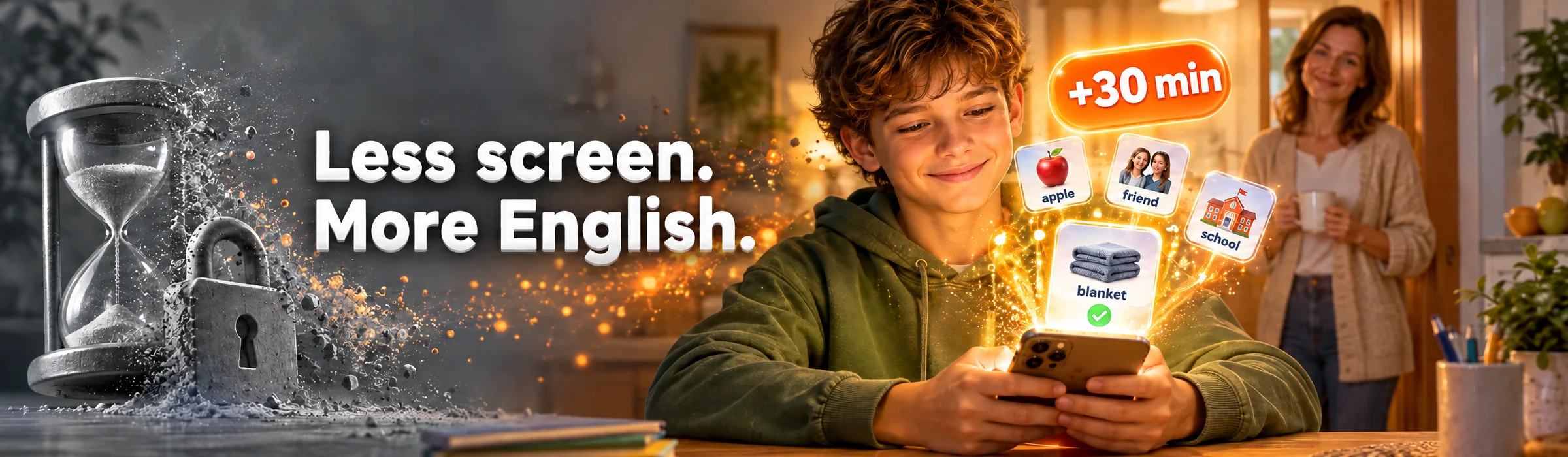
- Consistency without reminders. Games on the child’s iPhone unlock for minutes earned through the lesson, and the parent account also shows words learned, the day’s result, and the streak.
Mova does not assess live speaking — for that, you need a teacher or a checklist.
What to do with the result
A level below the curriculum expectation is the most common outcome: school alone usually isn’t enough. Here’s the plan:
- Record the starting point: date, method, result. In Mova, level history is saved automatically.
- Don’t try to “catch up in a month.” The next level usually takes 8–12 months; a short daily lesson works better than two hours on Saturday. The problem is that parents usually set a “20 minutes a day” plan and forget about it within a week. In Mova, the daily lesson keeps itself going: games, social media, and videos on the child’s iPhone are locked and only open for minutes earned through the English lesson (“Super” — 30 min, “Good” — 20 min), so there’s nothing to remind and nothing to track.
- Close the biggest gap — vocabulary. At A1–A2, what limits a child most is vocabulary, not grammar. In Mova, every word is repeated using the Leitner method: forgotten words come back tomorrow, learned ones return after longer and longer intervals.
- Add level-appropriate reading and listening. If reading in English hasn’t clicked yet, start with phonics — how to teach your child to read in English.
- Check again in 3–4 months using the same method. Half a step in that time is a good result.
For how to build lessons systematically, see our parent’s guide to English for children.

Frequently asked questions
What English level should a child have in 4th grade?
Under the Ministry curriculum — roughly A1: they understand simple phrases, answer questions about themselves, and read short texts. In reality, the level is often a bit lower — that’s common and not a reason to panic.
Is there a free English test for children?
Yes: sample papers for the Cambridge Starters, Movers, and Flyers tests. Regular online tests are designed for adults, so for a child the result is only very approximate. And in Mova, you can see the level without a test at all: it adjusts to daily lessons and appears in the parent account as “approximately grade N.”
What are Starters, Movers, and Flyers?
They are the three steps of Cambridge Young Learners tests for children ages 6–12: Starters is Pre-A1, Movers is A1, Flyers is A2. The tasks use pictures, there is no “fail” grade — the child receives a certificate with shields for each skill.
Does a child need a Cambridge certificate?
For school in Ukraine — no. It can be useful for motivation, but to understand the level, sample tasks or a checklist are enough.
My child is in 7th grade and has A1 instead of A2 — is that bad?
It’s a starting point, not a disaster. One level can realistically be made up in 6–12 months of short daily practice: A1 → A2 is primarily about vocabulary and listening.
Want to see your child’s level every day instead of once every six months — and without tests? Try Mova for free.
Read also: