
How Many English Words Should a Child Know? + The Oxford 3000 List
For A1, a child needs about 500 words; for A2, 1,000; for B1, 2,000+. The most practical benchmark is the Oxford 3000: a list of the most common English words from Oxford University Press, with each word marked by level from A1 to B1. Mova’s vocabulary is built on this list too.

Roman Shkabko · 7 min read
| Level | Approximate vocabulary size | What the child can do |
|---|---|---|
| A1 | ~500 words | Say hello, introduce themselves, name family members, colors, and animals; understand simple phrases from the teacher |
| A2 | ~1000 words | Talk about their day, school, and hobbies; understand a simple cartoon |
| B1 | 2000+ words | Watch shows with subtitles, read graded readers, keep up a conversation |
How level relates to age and school grade is covered in this article about a child’s English level.
What Oxford 3000 is and why it matters
The words were selected based on frequency and usefulness for learners. Its main advantage is the level label next to every word: filter by A1, and you get a beginner-friendly list. The breakdown is A1 — ~900 words, A2 — ~850, B1 — ~1250. There is also the Oxford 5000 (B2–C1), but children do not usually need it before their teen years.
The list is public: you can view it on the Oxford Learner's Dictionaries website and filter it by level.
You do not have to filter it manually. In Mova, every word has a difficulty score based on the same Oxford 3000 scale (A1 ≈ 100–300, A2 ≈ 300–550, B1 ≈ 550–800), and the daily words are automatically matched to the child’s level.
How many words are realistic at each age
| Age | Realistic vocabulary size | Comment |
|---|---|---|
| 5–6 years old | 100–200 words | Passive vocabulary from cartoons and songs, plus individual words and phrases |
| 7–9 years old | 300–600 words | Topics like “school,” “time,” and “food”; simple sentences |
| 10–13 years old | 800–1500 words | A solid A2: videos with subtitles, short texts |
| Teenager (B1) | ~2000 words | Shows, graded readers, conversations on familiar topics |
The first 100 words: a list in 10 topics
A beginner does not need 3,000 words — they need the first 100 A1 words for everyday situations.
1. Family
mother, father, sister, brother, grandmother, grandfather, family, baby, aunt, uncle
2. Colors
red, blue, green, yellow, black, white, orange, pink, brown, purple
3. Numbers
one, two, three, four, five, six, seven, eight, nine, ten
4. Animals
cat, dog, bird, fish, horse, cow, rabbit, mouse, bear, lion
5. Body
head, eye, ear, nose, mouth, hand, arm, leg, foot, hair
6. Food
apple, banana, bread, milk, water, egg, cheese, juice, cake, ice cream
7. Home
house, room, door, window, table, chair, bed, kitchen, bathroom, garden
8. School
school, book, pen, pencil, bag, teacher, friend, lesson, paper, picture
9. Actions
go, come, see, eat, drink, play, run, jump, read, sleep
10. Adjectives
big, small, good, bad, hot, cold, new, old, happy, sad
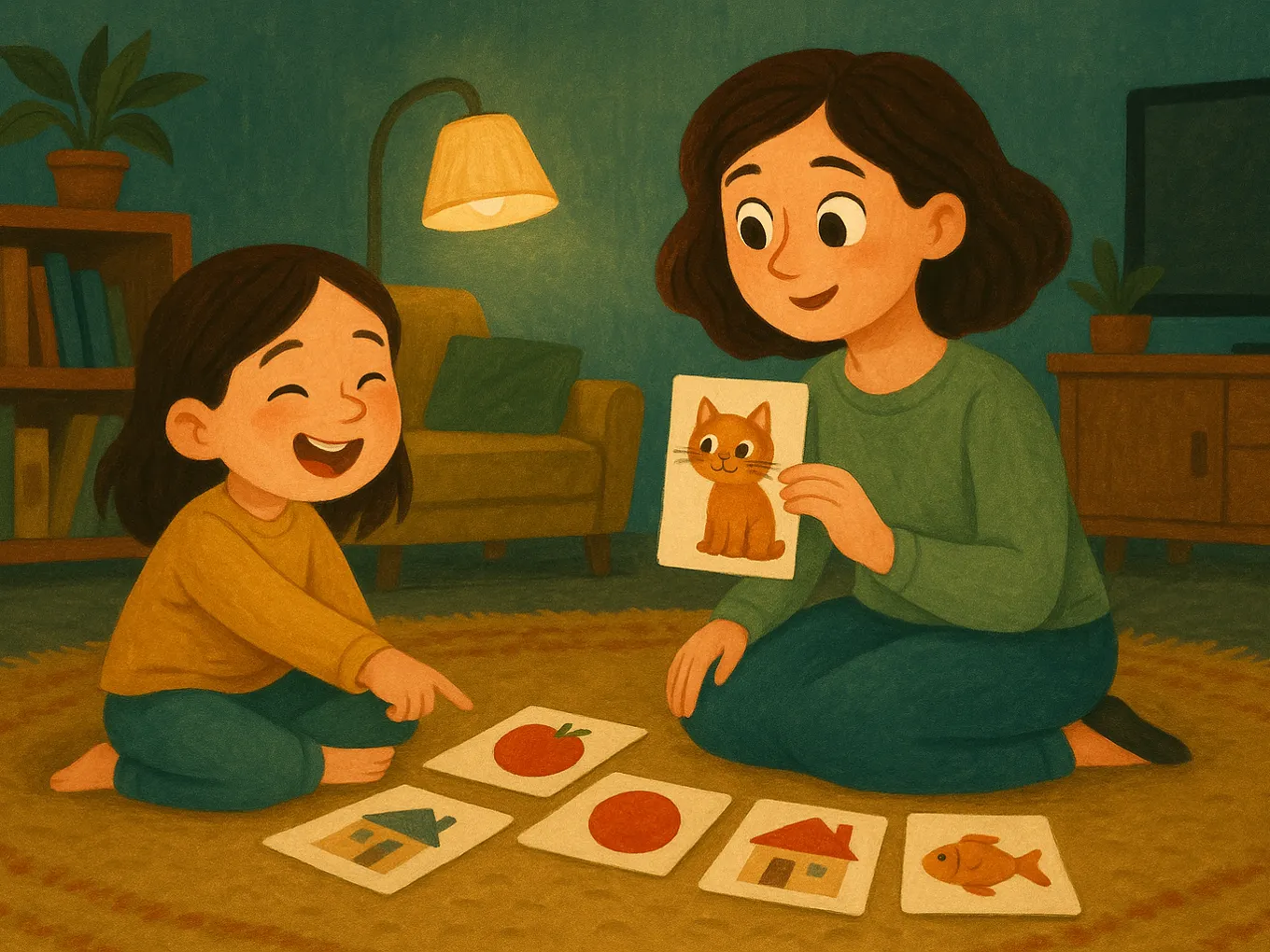
These topics work especially well with flashcards — how to make them is explained in a separate article.
How to count learned words
A word is learned when the child not only recognizes it in a text, but also uses it on their own — from a translation or a picture, several times with breaks of several days in between. The tables above refer specifically to this kind of active vocabulary.
How to work with the Oxford 3000 list
- Do not go alphabetically. Abandon, ability, able — different levels, no shared context.
- Stick to the child’s level only. For a beginner, that means A1: ~900 words instead of all 3,000.
- Use context. 10 words about food, or words taken from a short text, are remembered better than a random list.
- Use spaced repetition: after 1, 3, 7, 14, and 30 days. How to manage flashcards by hand is explained in this article about memorizing English words.
- Cross out what is already familiar once a month — visible progress is motivating.
How Mova teaches words from the Oxford 3000
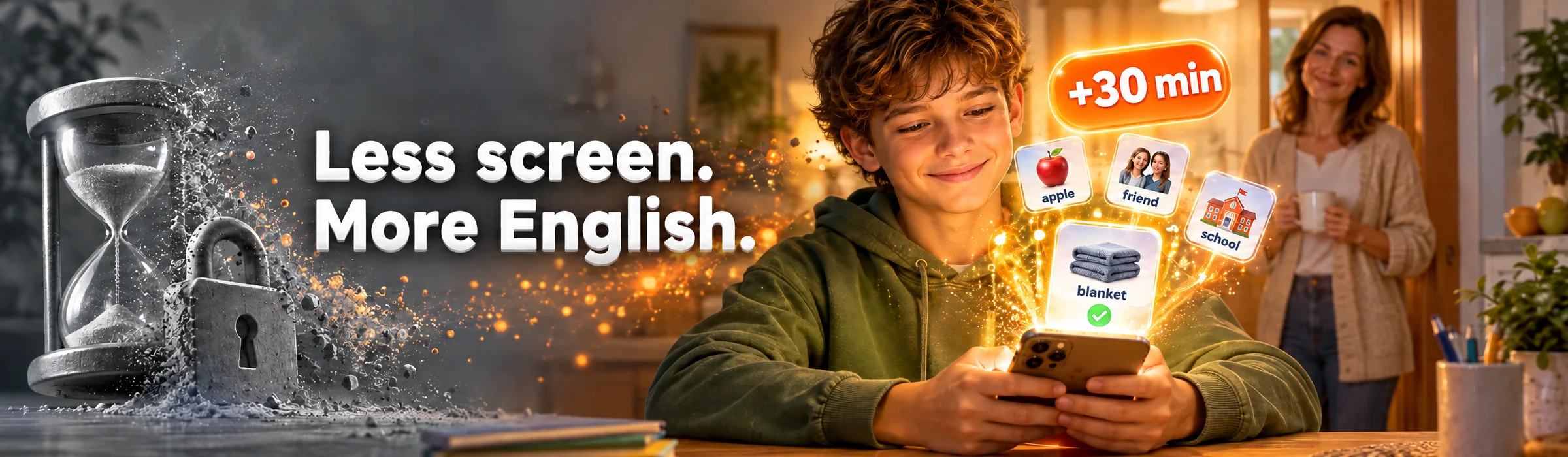
Done manually, this means spreadsheets, flashcards, and daily discipline. In Mova, the vocabulary is the same Oxford 3000 (A1–B1), and children study every day because games, social media, and videos on their iPhone are locked, and they earn screen time with an English lesson: an “Excellent” result gives 30 minutes, a “Good” result gives 20 minutes.
- The right level without filters. No placement test needed: every word has a difficulty score based on the Oxford 3000 level, and the child’s level adjusts daily to their results — from the easiest words up to B1.
- Words in context. 6 words and one rule in Words & Grammar, plus a text in Read & Write that they can read or listen to.
- Spacing is handled automatically. If correct, the word comes back after 1, 3, 7, 14, and 30 days; if wrong, it returns tomorrow.
- An honest definition of “knows it.” 4 correct answers with increasing gaps between reviews; walked or walking — any form of the word counts.
- Word count in the parent dashboard. In the browser, you can see how many words the child knows and how many they are learning.
How to turn words into a full learning system is explained in this guide to English for children.
Frequently asked questions
How many English words do you need to know to speak?
For simple everyday conversations, 1,000–1,500 of the most common words are enough — that is around A2 level. 2,000–3,000 words (B1) cover most everyday topics: films with subtitles, graded readers, and conversations on familiar subjects.
Is it enough to learn the 1,000 most common words?
The 1,000 most frequent words cover about 80% of everyday speech, so they are the best place to start. But the remaining 20% often carry the real meaning, so this is a milestone on the way to 2,000–3,000 words, not the finish line.
Does a child need to learn all 3,000 words from the list?
No. It only makes sense to work with the child’s current level: for A1, that is about 900 words. Some of them will be picked up from cartoons, games, and textbooks. The list is a map of gaps, not a cram plan from A to Z.
How many new words a day can a child learn?
5–7 for a school-age child and 3–5 for a preschooler, provided there is regular review. Without spaced repetition, less than half will remain after a week. 5 words a day is more than 1,500 a year — enough to move from one level to the next.
What is the difference between Oxford 3000 and Oxford 5000?
Oxford 3000 covers levels A1–B1. Oxford 5000 adds another 2,000 words from levels B2–C1 for more complex texts. For children before the teenage years, the first list is enough.
How can you check how many words a child already knows?
Manually: take 40–50 random words from their level and test both ways — English word → translation and the other way around. The share of correct answers roughly equals the share of familiar words at that level. In Mova, the parent dashboard shows this automatically: how many words the child knows and how many they are learning.
Want to see how many words your child actually knows, without flashcards or spreadsheets? Try Mova for free.
Read also: