

How to Help Your Child Learn Independently: The 15-Minutes-a-Day Habit
If you want your child to study independently, don’t make lessons longer — make them short and daily. 15 minutes at the same time, after the same trigger, with a predictable reward — and within 30 days it becomes a habit that works without your reminders. Below, you’ll find the habit mechanics and a plan in which your role gets smaller each week. For English, this system is already built into Mova: the lesson of the day unlocks games and videos for your child.

Roman Shkabko · 10 min read
Why 7 short sessions are stronger than 2 long ones
Two hours on the weekend may seem the same as 15 minutes a day. For a child’s brain, they’re not:
- Memory works through repetition, not duration. After 5–6 days without practice, some of it is forgotten, and the “long” session turns into re-learning the same thing.
- Low barrier to entry. Sitting down for 15 minutes is easy even when a child is not in the mood. Sitting for an hour is a feat that needs persuasion every time.
- “Every day” is a simpler rule than “twice a week.” There’s no need to decide each time whether to do it or not, and it’s exactly “maybe tomorrow” that ruins most attempts.
The yearly volume is almost the same, but the results and the level of resistance are incomparable.

How to build a habit: trigger → action → reward
If one element is missing, the whole structure falls apart, and parents end up back in the role of a “living alarm clock.”
- Trigger — the event after which the session always happens. Not “at 5:00 p.m.,” but after breakfast or right after school — every day, including weekends.
- Action — 15 minutes with a clear start and finish. The child knows in advance what to do: one page, one lesson in the app, one block of tasks. A timer takes the bargaining out of “how much longer?”
- Reward — immediately after the action. For a school-age child, the most natural one is screen time: first the lesson, then games. For younger kids, it’s a sticker in a tracker: 7 marks in a row — a small prize.
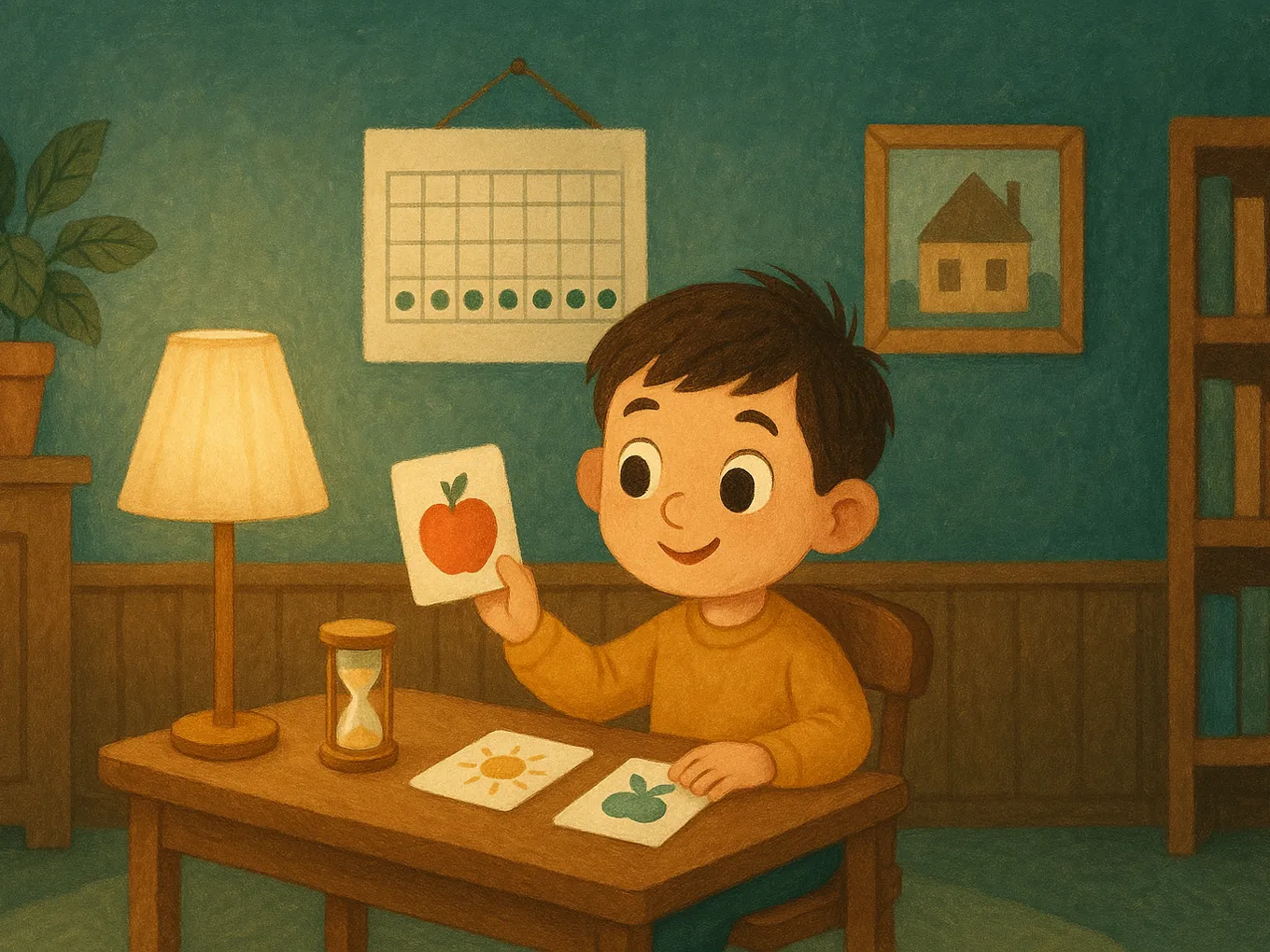
Example for a second-grader: school → snack → 15 minutes of English on a timer → cartoons. For a teenager: breakfast → lesson → phone unlocked. The order never changes, and the reward is never given in advance.
Mova: trigger, action, and reward work on their own
The weakest link in the system is you. A timer, a tracker on the fridge, and “lesson first, games later” work only while someone remembers, checks, and gives the reward every day. After a week or two, usually no one is doing that anymore — and the habit falls apart along with the system. Mova does this work for you for your child’s English on iPhone:
- The reward is built in. Games, social media, and videos are blocked by Apple’s system tools and open only for minutes earned through lessons: “Great” — 30 minutes, “Good” — 20, all the day’s tests rated “Great” — another +10. You don’t have to count anything or unlock anything manually.
- The trigger is the phone itself. The child wants to play — sees there are no minutes left — and opens the lesson. No reminders needed.
- The action is defined in advance: Read & Write (text and questions) and Words & Grammar (6 words and 1 rule with a test). Words are repeated using the Leitner method — exactly when they start to be forgotten.
- The streak works like a tracker. Consecutive days are counted automatically, and every 5 days brings bonus minutes.
- If it doesn’t work out, there’s no drama. Missed the test — a new attempt an hour later with different questions.
- You see the result, not the process: in the web dashboard — each day’s result, streak, level, and learned words. How many minutes each test gives and whether unused ones expire overnight is up to you.
So for English, the “trigger → action → reward” formula is already assembled: all you need to do is set up the rewards once and watch the results.
A 30-day plan: the parents’ role shrinks every week
Parents usually either control everything or let go right away. What works is gradually handing over the wheel. It’s easy to fit sessions into the schoolchild’s daily routine.
| Week | What we do | Parents’ role |
|---|---|---|
| Week 1: start | Together, you choose the trigger and reward, and hang up the tracker. The main goal is to sit down, not to do a lot. | Maximum involvement: you remind, sit nearby, and praise the fact of doing the session. No criticism of quality. |
| Week 2: reinforcement | The same trigger. The child sets the timer and opens the materials themselves. | You’re in the room, but busy with your own thing. You answer only if the child asks. |
| Week 3: letting go | The child starts after the trigger without reminders (at most one “gentle” reminder a day). | You check only the result at the end. You don’t interfere with the process. |
| Week 4: autonomy | The full cycle on their own: trigger → session → reward. At the end of the week, a short talk about what was easy and what wasn’t. | Spot checks 1–2 times a week. Control is replaced by interest. |
If they still don’t start on their own in week 3, take a step back.
With Mova for English, this plan compresses: from the very first week, you’re already in “week 4” mode. The lesson, reward, and streak are handled automatically, and once a week you just check the dashboard and ask what was most interesting.
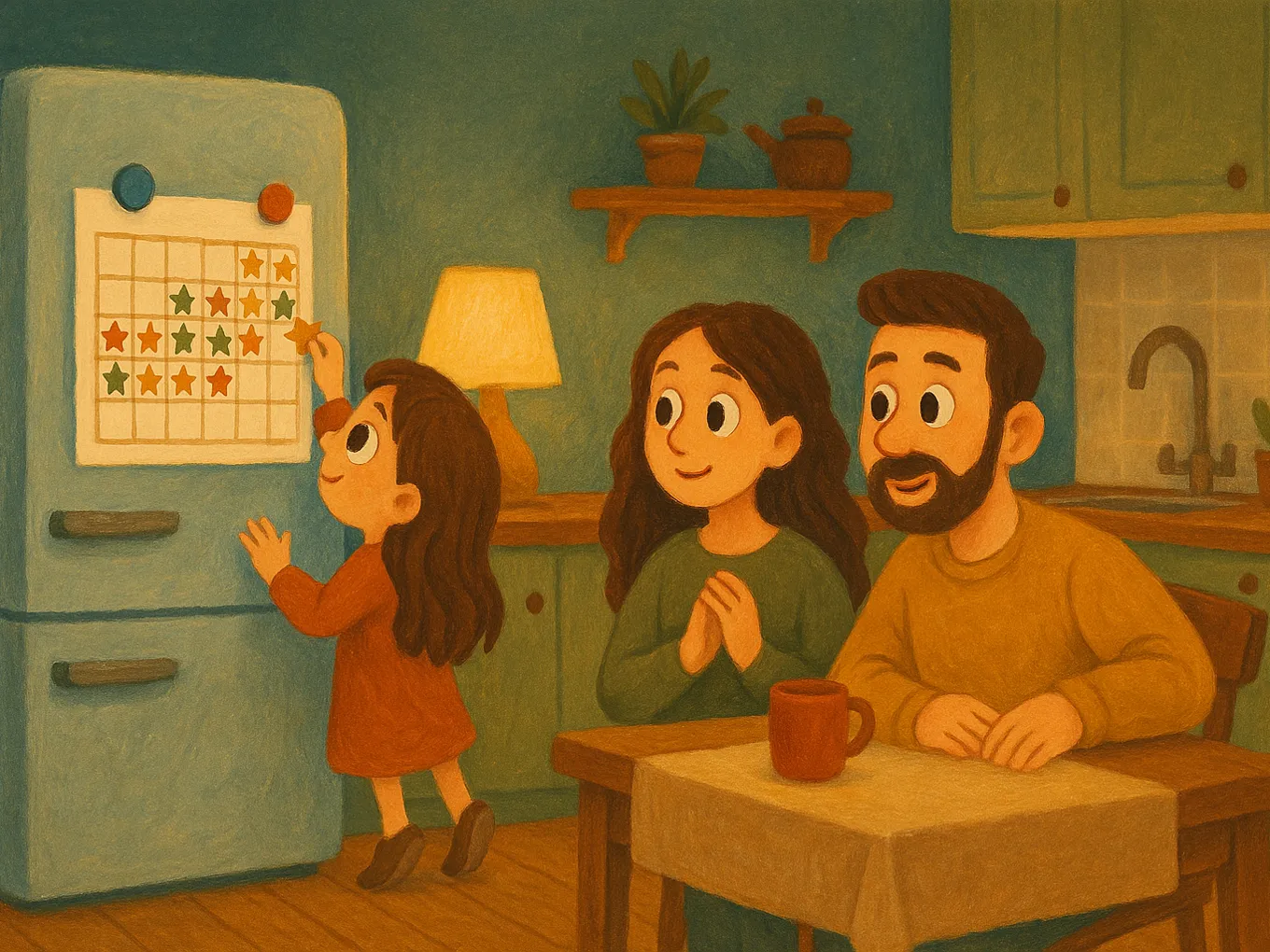
Independent lessons: how to transfer responsibility step by step
The same logic works for school homework too. Jumping from “I sit next to them” to “do it yourself” won’t work — there are four steps in between:
- We sit beside them. You don’t solve it for the child; you simply bring their attention back to the task. This stage is for grades 1–2.
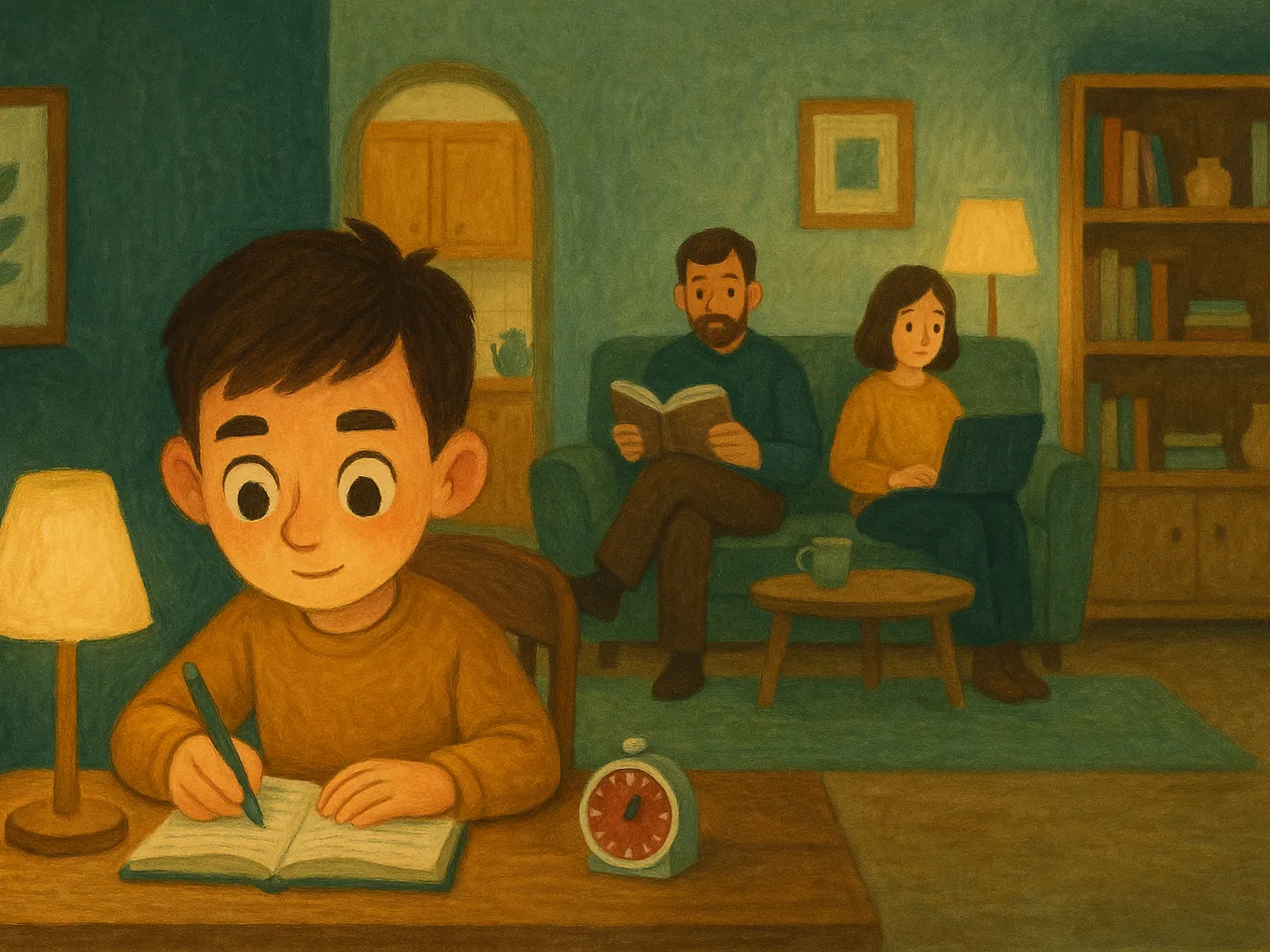
- Nearby in the same room. The child works alone; you do your own thing. Questions are okay, hovering over them is not. Most 8–9-year-olds are ready for this within a few weeks.
- We check the result. You look only at the finished work — not with a red pen, but with the question “what was the hardest part?”
- We trust them. Check once a week or on request; responsibility is with the child, along with the natural consequences at school.
Stay at each stage for 1–3 weeks. If the main obstacle is a phone on the desk, read how to remove distractions without taking the phone away.
Common setbacks and what to do
Missed 3 days in a row
One missed day won’t break the habit. Three is a reset signal: without blame, return to the trigger and cut the target in half for a few days. Don’t “work off the debt” with double sessions — that creates resistance and hides the main point, which is consistency. In Mova, for example, a missed day only costs the streak and unearned minutes: there’s nothing to catch up on, just a new lesson the next day.
Holidays
The school routine disappears, and with it the triggers. Tie the session to breakfast, not to coming home from school. The duration can be reduced, but “every day” should not. With Mova, the trigger doesn’t disappear during holidays either: games and videos still open only after the lesson.
“I don’t want to”
A one-off “I don’t want to” is best handled by making the step smaller (“just 5 minutes today”) and offering a choice without the option of “not doing it”: now or in half an hour. If “I don’t want to” goes on for weeks, reconsider the difficulty level and read why a child doesn’t want to learn and what parents can do. Tasks that are too hard are a common reason: in Mova, the difficulty adjusts daily to the result, so the lesson is never either overwhelming or boringly easy.
Parent mistakes that kill the habit
- Controlling every minute. Comments on every answer teach the child that studying is an unpleasant time with a supervisor. Control the result, not the process.
- Punishing by taking away something they love. “No session — no practice” turns learning into a source of loss. Not getting the reward is punishment enough.
- Setting the bar too high. “15 minutes is nothing serious, let’s do an hour” — and in two weeks there will be neither an hour nor fifteen minutes.
- Expecting gratitude. The first week is resistance, the second is bargaining, and only then comes a neutral “I’m going to study.” That is the win.
In one sentence: build a system where the right behavior is the easiest path, and gradually step out of it yourself.
Frequently asked questions
How many days does it take to build a habit in a child?
Think in terms of 30 days for a stable routine and 2–3 months for it to become automatic. The “21 days” idea is a myth: simple actions stick faster, more complex ones take longer. The main sign is that the child starts the session without your command.
At what age can a child do homework independently?
In grades 1–2, an adult is still needed nearby — for support, not for hints. From ages 8–9, most children can work on their own if parents check the result. At 10–11, full responsibility can be handed over, leaving yourself only spot checks once a week.
Is 15 minutes a day too little to make a difference?
For a habit, it’s ideal. 15 minutes a day adds up to more than 90 hours a year, and each session reinforces the previous one before memory has a chance to “cool off.” Once the habit is established, the duration can easily be increased.
Can you pay a child for lessons or grades?
Money for simply doing the session is risky: once the payment disappears, so does the motivation. Rewards tied to what the child wants work better: screen time, shared play, a sticker in a tracker. Mova is set up exactly that way: the child earns game minutes with English lessons, and you decide how many.
What if the child flatly refuses to study?
Lower the bar to 5 minutes or one exercise and offer a choice without the option of “not doing it”: now or after a snack. If resistance lasts for weeks, check whether the tasks match the child’s level and whether the refusal is tied to school.
Want daily English to stick without your reminders? Mova gives the lesson, counts the minutes, and unlocks games only for what’s earned. Try Mova for free.
Also read:
- Lessons with a phone in hand: how to remove distractions without taking the phone away
- A schoolchild’s daily routine: a template with both lessons and phone time
- What to keep a schoolchild busy with instead of a phone: after school and in summer
- A child’s English level by age and grade: how to check it
- How much English for a child costs: tutor vs courses vs app