

My Child Doesn’t Want to Study: Reasons Why and What Parents Can Do
If your child doesn’t want to study, in 9 out of 10 cases the reason isn’t laziness but one of seven specific problems: from “I don’t see the point” to “my phone is more interesting.” Find your reason in the list below, use the action next to it — and add a simple reward system where something pleasant comes after the work is done. Yelling and punishment only reinforce the problem.

Roman Shkabko · 14 min read
7 real reasons your child doesn’t want to study
There’s no such thing as a universally “unmotivated child.” There is always a specific reason, and each one calls for a different response.

- It’s boring. The material is presented in a monotone way, without play or competition. What to do: change the format, not the pressure: a “finish in 10 minutes” timer, a quiz instead of retelling, asking your child to explain the topic to you “like a teacher.” A change of format often helps more than an extra hour of drilling.
- They don’t see the point. “Why do I need these fractions?” is an honest question a child may never have gotten an answer to. What to do: connect the subject to their world: percentages to pocket money, English to games and YouTube. Not “you’ll need it in life,” but “tonight you’ll be able to do this.”
- Fear of making mistakes. A child who gets scolded for mistakes chooses not to make them at all — which means not doing the work. What to do: praise the effort, not just the result: “you figured out the second problem on your own” instead of “why is the third one wrong?” A mistake in a draft is part of the process, not grounds for a lecture.
- Conflict with the teacher. Often a child doesn’t want to study one subject, not “study at all.” What to do: ask separately about each subject. If the problem is only with one, talk to the teacher without the child present and without accusations: “what can I do on my side?”
- Overload. School until 3:00 p.m., two extracurriculars, a tutor — and a “lazy” child who is actually exhausted. What to do: calculate your child’s real week in hours. If they have less than 1.5–2 hours of free time a day, drop one activity. We broke down a schedule that includes both lessons and rest in our article on the daily routine of a schoolchild.
- Gadgets are winning the competition. TikTok gives a reward every second; math homework gives one maybe twice a year on the report card. It’s an unfair contest, and a child’s willpower won’t fix that. What to do: change the order: study first, then screen time. Not “phone or homework,” but “phone after homework.” That’s exactly how Mova works: games, social media, and videos on your child’s iPhone stay locked until they complete an English lesson, then unlock for earned minutes — no reminders or bargaining. Parents set manual limits in Screen Time and forget about them, but here the routine holds itself. Screen Time is still useful for what Mova doesn’t do: content filtering, Ask to Buy, and location sharing through Family Sharing. For more on how to do this without a war, see the article how to wean a child off their phone.
- Age. At 6–7, play matters more than learning; at 11–14, peers and status matter more. This isn’t a defect, it’s development. What to do: adapt the format to the age: for younger kids, learning through play in 10–15 minute bursts; for teens, autonomy and a connection to their own goals (more on that below).

What does NOT work (even though almost everyone does it)
- Yelling and fights. A stressed child physically remembers less well. After an argument over homework, they’re thinking about hurt feelings, not the assignment. The result: homework becomes associated with feeling bad, and their willingness to sit down and do it drops even lower.
- Comparisons. “Why can’t you be more like Mary…” doesn’t spark motivation — it tells the child, “you’re worse.” Some respond with rebellion, others with a quiet “I’m hopeless anyway, why try?” The only useful comparison is with their own past self: “last week there were 5 mistakes, now there are 2.”
- Using learning as punishment. “For that, you’ll write two extra dictations” is the fastest way to make a child hate dictations. Learning cannot be both a value and a punishment at the same time. The reverse is harmful too: canceling learning as a “reward” (“good job, you don’t have to read today”).
- Total control. Sitting next to your child for every exercise takes responsibility away from them. They learn not “to do homework” but “to do homework while Mom is watching.” For how to hand over responsibility gradually, see the article how to teach a child to study independently.
External and internal motivation in simple terms
External motivation means doing something because you’ll get something from outside: points, screen time, praise. Internal motivation means doing it because it’s interesting or because you can see your own progress. Internal motivation is stronger and lasts longer, but parents can’t switch it on at will.
The practical conclusion is this: you don’t need to choose between them. External motivation is the engine starter: it gets the child to begin and repeat the action until a habit and the first results appear. Then, when the child notices, “I can already read this without a dictionary,” internal motivation kicks in. The mistake is demanding internal motivation from day one (“you have to want it yourself!”) or staying stuck in external motivation forever, constantly raising the stakes.
So the working plan is: an external reward system at the start → small visible wins → a gradual reduction of rewards once the habit is established.
A reward system for your child: how to make it work
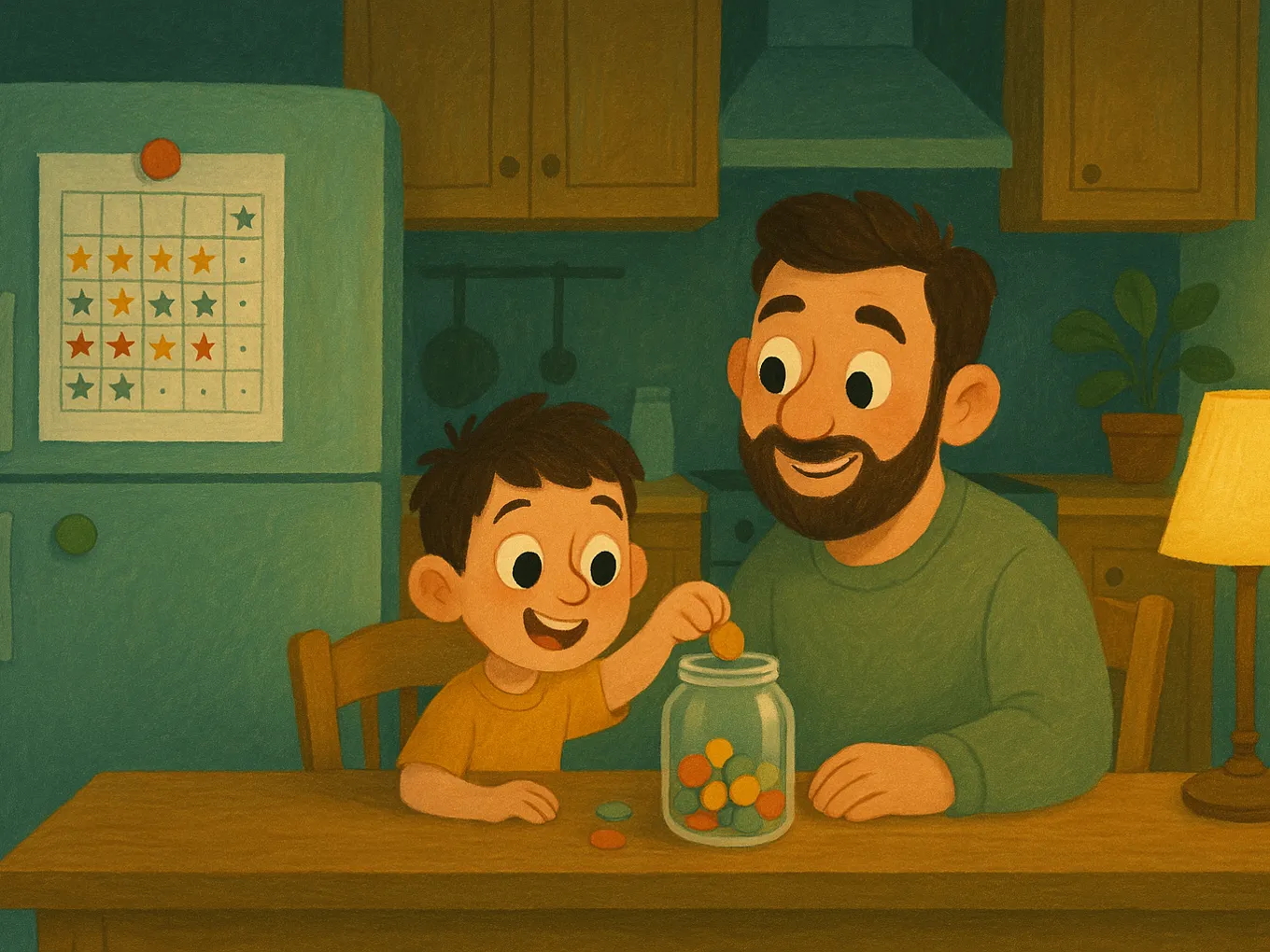
The classic manual version is a “behavior → points → reward” chart on the fridge, or tokens in a jar for younger kids. The child can literally see progress, and the reward becomes predictable rather than dependent on the parents’ mood. Honestly, in most families that chart fizzles out after a week or two — parents set it up and forget it, nobody counts the points, and “but I did it yesterday!” turns into a new argument.
| Behavior | Points | Reward (examples) |
|---|---|---|
| Started homework independently, without reminders | 2 | 10 points — +30 min of screen time on the weekend 25 points — a movie or board game with parents 50 points — a trip to an amusement park / a desired item up to about 500 UAH (approx., 2026) |
| Finished all homework by 6:00 p.m. | 3 | |
| A lesson in Mova (≈15 minutes of English) | 2 | |
| Packed their school bag for tomorrow on their own | 1 | |
| A full week without skipping — bonus | 5 |
If you’re keeping the chart manually, here are the rules without which it falls apart within a week:
- Points are given for the action, not the grade. “Sat down and did it” depends on the child; “got an A” does not always.
- Points are not taken away for misbehavior. The moment you start subtracting them, the chart turns into a punishment tool, and the child stops wanting to play along. Handle discipline with separate agreements.
- The reward has to come quickly. Younger schoolchildren need the first “prize” within 2–3 days, or interest fades. Long-term goals (50 points) can be added as a second level, not the only one.
- The rules do not change retroactively. “Well, that was too easy, now it’s only worth 1 point” — and trust in the system is gone.
- No more than 4–6 behavior items. A 15-row chart doesn’t work for either the child or the parents.
A ready-made reward system without the fridge — Mova
Mova handles all five rules above automatically, so parents don’t have to count or remind. Every day, an English lesson is waiting on the child’s iPhone, and the minutes for it are awarded automatically: a “Super” test score gives 30 minutes, a “Good” score gives 20, and all the day’s tests scored “Super” add another +10. The child can see the balance themselves, and games, social media, and videos unlock only for earned time. The reward comes immediately, the rules don’t change after the fact, and only you can change or disable rewards in the web dashboard. Save the fridge chart for things like packing the school bag and homework — Mova already manages the main reward, screen time, for you.
Should you pay a child for grades?
Let’s honestly look at both sides, because there is no simple answer like “psychologists forbid it.”
| Arguments in favor | Arguments against |
|---|---|
| It works fast: the child really does start trying harder | The effect lasts only as long as you keep paying, and you usually have to keep raising the stakes |
| The rules are clear: result equals reward, like a salary for adults | A grade doesn’t depend only on the child: teacher subjectivity destroys faith in the “fairness” of the deal |
| A reason to talk about money and teach how to manage it | It creates an incentive to cheat or beg for points — because you’re paying for the number, not the knowledge |
Conclusion: paying for grades is a bad deal; rewarding the process is a workable one. Reward what is fully under the child’s control: sitting down to homework independently, studying for 15 minutes, reviewing words. And ideally not with money, but with something the child values right now — above all, screen time. For a schoolchild it’s often worth more than 50 UAH, it doesn’t teach them to measure learning in money, and it fits naturally into the day: do your part, get your screen. That’s exactly how Mova works: the child gets screen minutes for completing an English lesson, not for a grade in the gradebook, and that deal is fair because the result depends entirely on them.
A teenager doesn’t want to study: what’s different
What works for an 8-year-old gets eye-rolls from a 14-year-old. If a teenager doesn’t want to study, keep three things in mind:
- Stickers and tokens don’t work — autonomy does. Not “I decided you’ll study chemistry every day,” but “what is your goal this semester, and what does it take to get there?” Agreements instead of commands: the teen chooses when to do the work, and you only define the deadline and the minimum.
- Meaning matters more than reward. “You need it for university” is an empty phrase when that’s four years away. Tie it to near-term goals: earning money, internships, a gaming community, moving abroad, English-language content. Allow unevenness: 2–3 subjects “all in” for the goal, the rest at an honest minimum.
- Status and peers matter a lot. A teenager won’t forgive public humiliation over grades (in front of the class, friends, or the family group chat) and will respond with sabotage. All difficult conversations should happen one-on-one and without “I told you so.”
And separately: a sudden drop in performance over a month or two is not just “getting lazy.” It can happen with bullying, first love, sleep problems, or depression. First have a calm conversation and rule out those causes, and only then move on to motivation systems.
If your child doesn’t want to learn English
English is a special case: results stay invisible for months, so “I don’t want to” is especially common here. What to do if your child doesn’t want to learn English:
- Shorten the session to 10–15 minutes a day. That’s manageable even for a child who “hates it,” and for language learning consistency matters more than duration. In Mova, that means one daily lesson, and skipping it won’t go unnoticed: no lesson means no minutes for games.
- Tie the language to their interests. Games, favorite YouTubers, shows without dubbing — English as a key to something exciting, not just a school subject. In Mova, English literally becomes a key: the lesson unlocks games and videos for earned time.
- Make progress visible. A counter of learned words or a streak of consecutive days motivates better than an abstract “study it, you’ll need it.” For how to organize review so words don’t get forgotten, see the article on spaced repetition for children. In Mova, this is already built in: your child’s level adjusts automatically, without a placement test, words are reviewed using the Leitner method, and in the web dashboard you can see how many words your child already knows and how many they’re learning.
- Don’t leave it all to school. Two lessons a week are not enough for a language, and practice at home is possible even if you don’t know the language yourself — we explained it step by step in the article how to practice English with your child at home.
All four points together are exactly what Mova is: a daily English lesson on your child’s iPhone, a level that adjusts automatically, spaced repetition of words, and progress tracking in the parent dashboard. And the motivation to sit down for the lesson comes not from your reminder, but from locked games that open up for earned minutes.

Frequently asked questions
What if my child doesn’t want to do homework specifically in the evening?
Move homework to before 6:00 p.m. — after that, a schoolchild’s brain is already tired, and every task takes twice as long. Agree on a fixed slot right after a 30–60 minute break after school. Leave the evening for reading and calm activities.
My child doesn’t want to study in first grade — is that normal?
At 6–7, play is still more important than study, and that’s normal. The problem isn’t the child, it’s the format: 40 minutes at a desk is a lot for a first-grader. At home, learn in short 10–15 minute blocks through play, not sitting at a table “like at school.”
Will a tutor help if my child doesn’t want to study?
A tutor can fill knowledge gaps, but they do not create motivation. If the child has fallen behind and given up because of that — yes, it can help. If the reason is boredom, conflict with a teacher, or gadgets, a tutor will just become one more obligation. Find the reason first.
How long does it take for a reward system to start working?
The first effect is visible in 3–5 days; a stable one in 3–4 weeks. The critical point is the second week, when the novelty wears off. If you can get through the first month without changing the rules, the system becomes a habit and keeps working with almost no effort.
My child doesn’t want to study because of the phone — should I just take the gadget away?
Taking away the phone gives you a week of fights and zero motivation: the child thinks about getting the phone back, not about learning. What works is a different order — first a short required block of study, then screen time as a reward. That way the gadget stops competing with homework and starts working for it.
My teenager doesn’t want to study and says school is useless to anyone. What should I say?
Don’t argue about “school in general” — he is partly right, and you’ll lose that debate. Shift the conversation to his goals: money, a profession, moving abroad, gaming, a blog. Then together identify 2–3 subjects that truly lead to that goal, and agree on a minimum for the rest.
The hardest part of any motivation system is keeping it going every day: assigning points, reminding, and holding the line on “study first, then screen.” In the mova.family app, that rule is built into the child’s iPhone itself: games, social media, and videos are locked by Apple’s system mechanism, and the child earns minutes for them with a daily English lesson — a “Super” test gives 30 minutes, a “Good” test gives 20, and all the day’s tests marked “Super” add another +10. The lesson unlocks the minutes, not Mom after negotiations, so the daily arguments of “go study first” simply disappear from the routine. You set up the rewards yourself, track progress in the web dashboard, and without your PIN the blocked list cannot be changed. Motivation stops being a battle and becomes part of the day.