

How to Practice English at Home with Your Child If You Don’t Know the Language
You can help your child learn English at home without knowing the language yourself. Cartoons, flashcards, and an app can handle the words and grammar — your role is different: structure and consistency. You set the time, turn on the right material, and track progress instead of translating.

Roman Shkabko · 11 min read
This is not a compromise “for lack of anything better.” Children absorb language through repeated exposure in a context they understand, and parents are better placed than anyone to provide that repetition — because they see their child every day. Below, you’ll find where to start with English at every age, 7 practical strategies for parents who don’t speak English, and a ready-made weekly plan.
Where to start by age
The question of “where to start” depends on your child’s age, not on the textbook. The overall principle is the same: first listening vocabulary, then reading, and only after that grammar.
Ages 5–6
- Only spoken language: songs, short cartoons in English for 5–10 minutes, and the names of everyday objects around them.
- The first goal is 50 words by ear: colors, animals, food, body parts. The child points and names them, not writes them.
- The alphabet and letters should come only after the child is confidently reading in their native language. Otherwise, the reading rules of the two languages get mixed up.
Ages 7–9
- Words by topic, 5–7 at a time: family, school, home. It’s easiest to use ready-made topic-based word lists so you don’t have to come up with them yourself.
- Next comes reading simple words and short sentences — but only after the child already recognizes the word by ear.
- The main task at this age is building a daily 15-minute habit. Time matters more than volume.
Ages 10–13
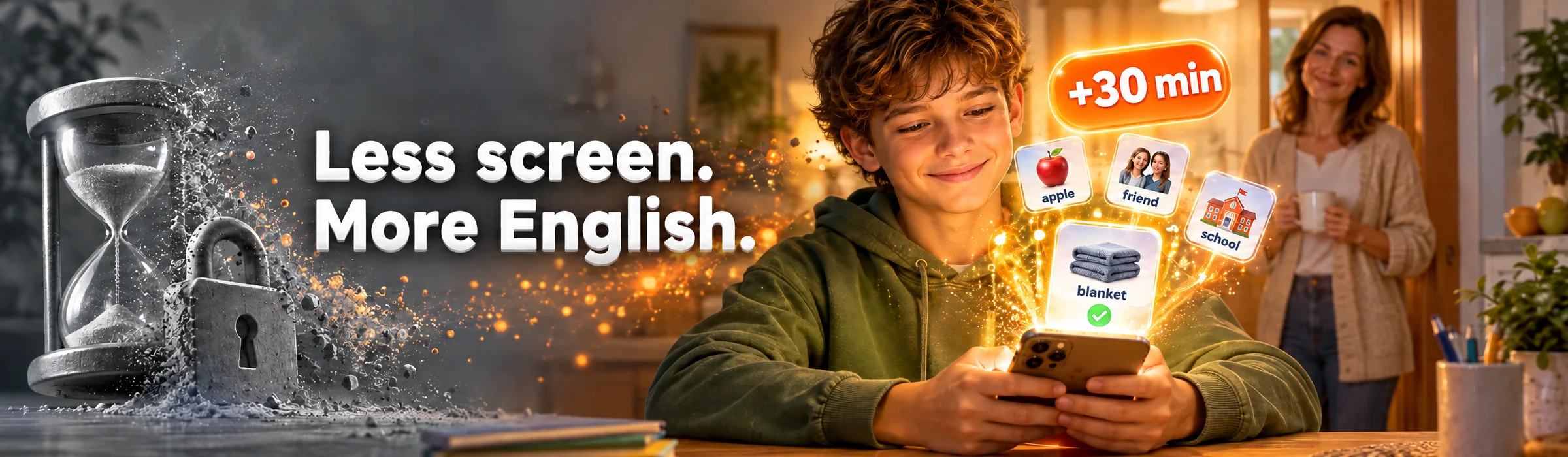
- Shift most of the learning into an independent format: a daily app lesson that adjusts the level automatically and checks answers on its own. That’s how Mova works on iPhone: your child’s level adapts automatically, without a placement test, and games, social media, and videos unlock for minutes earned through lessons — 30 minutes for an “Excellent” test result, 20 for “Good.”
- Add content that matches their interests: videos about gaming, sports, or music in English with subtitles.
- Your role is not to “sit beside them,” but simply to check once a day that the lesson was completed.
Teenagers 14–17
- Agree on a goal your teenager genuinely accepts as their own: watching shows without dubbing, gaming servers, the NMT, or studying abroad.
- The format should be fully independent: an app plus daily content in English. Supervision comes down to checking progress once a week.
- Don’t try to test their knowledge yourself — teenagers find that even more irritating than younger children do. Trust the numbers: how many lessons they’ve completed and how many words they’ve learned.
If you want the full picture — how much to study, what levels there are, and when it makes sense to bring in a tutor — start with this guide to English for children.

What parents who don’t speak English can do: 7 practical strategies
None of the strategies below require you to pronounce English or understand it yourself. Together, they cover the full cycle: new words → review → use.
- Cartoons with pauses. Put on a cartoon at your child’s level and pause every 2–3 minutes: “What did he say? What’s going to happen now?” Your child retells it — you listen in Ukrainian. You’re not checking their English, you’re checking their understanding, and that’s completely within your reach.
- Word flashcards. A picture on one side, the word on the other. Your job is to show the picture and compare the answer with what’s written. Pronunciation comes from the phone audio or the cartoon, not from you. To learn how to review flashcards so words actually stick, see the article on spaced repetition and the Leitner method.
- Labeled objects around the house. Stickers on the mirror (mirror), door (door), fridge (fridge) — 10–15 at a time, and switch them out every two weeks. A word a child sees twenty times a day in context doesn’t need to be memorized by force.
- Audio in the background. Songs and simple podcasts in English in the car, over breakfast, while cleaning up. Background audio doesn’t teach vocabulary by itself, but it trains the ear to the sound of the language — and children start recognizing the words they know from flashcards in the flow of speech.
- Games. Five minutes of play gives more repetition than half an hour of “sit down and study”: “I spy” with colors, bingo with flashcards, speed word games. For a selection of ideas with and without gadgets, see the article on games for learning English.
- Reviewing progress together. Once a week, open the stats together: how many words have been learned, how many days in a row they’ve kept going. Not “I’m checking up on you,” but “Look how much you’ve already done.” For a child, that feels like recognition; for you, it’s oversight without needing the language.
- The 15-minute habit. The same time every day — after breakfast or right after school. Tie it to an event, not the clock: “after dinner = English.” For the first three weeks, you do the reminding; after that, the habit starts carrying itself. If you don’t have the energy to remind them, Mova can take over: games and videos on your child’s iPhone unlock only for minutes earned through an English lesson, so your child sits down to do it on their own — without your involvement or any knowledge of the language.

What NOT to do
Don’t translate every word. If after every phrase in a cartoon your child hears a translation, the brain stops working with English — why bother, if everything will be explained anyway? Understanding from context, even if it’s incomplete, is the learning. Translate only what’s necessary to keep the storyline clear.
Don’t make them memorize lists by heart. Thirty words in a notebook column will be forgotten within a week: memory keeps words that come back on different days and in context, not all in one evening. Five words today, with review tomorrow and again in three days, works better than 30 at once.
Don’t study “when the mood strikes.” Lessons done only “when there’s time and desire” turn into twice a month, and every time you’re starting from scratch. Missing a day is normal. Missing randomly without any system is not: it’s consistency — not talent and not your English — that determines the result.
A weekly plan: 15 minutes a day
This template is for a child aged 7–10. Swap in age-appropriate activities, but keep the structure the same: two days for new words, the rest for review and use.
| Day | 15-minute activity |
|---|---|
| Monday | 5–7 new words from one topic: flashcards or a lesson in the app |
| Tuesday | Review yesterday’s words + a 10-minute cartoon with one pause for retelling |
| Wednesday | Game with this week’s words: bingo, “I spy,” speed word games |
| Thursday | 5–7 new words from the same topic + a quick review of Monday’s words |
| Friday | Cartoon or song; the child names all the familiar words they heard |
| Saturday | Review all the week’s words + refresh the stickers on household objects |
| Sunday | Review the week’s progress together; a cartoon with no tasks attached — just for enjoyment |
At this pace, a child learns 10–14 new words per week with review — about 500 words a year. That’s noticeably more than a typical school program gives in the same amount of time.
English in summer: how not to lose it over the holidays
After two or three months without practice, a child can slip back by about half a year: first the newest words disappear, then confidence goes with them. In autumn, you’re no longer moving forward — you’re catching up. Maintaining a level is much cheaper than rebuilding it, and 10–15 minutes a day is enough.
The summer routine should be different from the school-year one: fewer “lessons,” more language around them.
- The daily minimum stays. One short lesson or one set of flashcards a day — even at camp or at grandma’s. Fifteen minutes can be found anywhere there’s a phone.
- No new words — just review. In summer, you don’t have to expand vocabulary; you can simply keep cycling through what was learned during the year. That keeps the foundation strong without making it feel like “studying during vacation.”
- Travel time is English time. Audio stories and songs in the car, “I spy” while waiting in line, travel words like airport, ticket, sea.
- Screen time becomes your lever. Kids are on their phones more in summer, and you can use that: lesson first, then games and videos. The “screen after English” setup works even better in summer than during the school year, because the motivation to get phone time is stronger. In Mova, this is built in: daily lessons earn minutes, and whether unused minutes disappear overnight is up to you — so no stockpiling them for a marathon session.

How to tell there’s progress if you don’t understand the language
You don’t need to evaluate pronunciation or grammar — progress shows up in behavior and numbers:
- Your child recognizes words in running speech: they laugh at a joke in a cartoon before looking at you, sing along with songs, react to familiar phrases.
- Words start appearing in daily life: they comment “this is a cat,” name colors or foods in English without being asked.
- The numbers go up: total words learned, consecutive days without missing, percentage of correct answers in tests. That’s more objective than any “checking” you could do yourself — which is exactly why app statistics are even more valuable for parents who don’t know English than for those who do.
- Resistance fades: your child sits down for their 15 minutes without a reminder. A habit is also a result — and in the long run, it’s the most important one.
Every 2–3 months, do one simple checkpoint: in 5 minutes, your child names everything they see in a picture scene or retells an episode of a familiar cartoon. Compare not with perfection, but with how it went last time.
Frequently asked questions
Can you help your child learn English if the parents don’t know the language at all?
Yes. The materials will explain the language to your child: cartoons, flashcards, and an app with audio. The parents’ role is schedule, consistency, and attention to progress. That’s organizational work, not teaching, and it doesn’t require English.
Where should you start teaching a child English from scratch?
Start with spoken words on familiar topics: family, colors, animals, food. For preschoolers — songs and cartoons; for school-age children — flashcards plus a short daily lesson in an app. Add the alphabet and reading after the first 50–100 words are familiar by ear.
How much time should you spend learning English with your child at home?
15 minutes every day. That’s enough for steady progress and short enough not to trigger resistance. Fifteen minutes daily works better than an hour once a week, because language depends on repetition, not one-off effort.
How do you teach English words to a child so they don’t forget them?
Return to each word at increasing intervals: the next day, then after 3, 7, 14, and 30 days. Consider a word learned once the child has named it correctly several times in a row on different days. This is easy to track manually with flashcards, or automatically with an app that uses spaced repetition.
Do you need a tutor if you’re studying English at home?
At the beginning — no. A child can build vocabulary and a learning habit independently at home. A tutor becomes useful later for speaking practice and pronunciation correction, once there’s already a foundation of words and simple structures. Then the tutor’s time is spent on what can’t be recreated at home.
How can you help your child with English if they’re getting bad grades at school?
Bad grades almost always point to a gap in the foundation: too few words and a fear of making mistakes. Don’t put pressure on the grades — go back to a level below the school program and fill the gap with daily 15-minute sessions: topic-based vocabulary from the textbook plus simple sentences. The grades will improve as the foundation catches up.
The hardest part of English at home isn’t the materials — it’s the daily routine: reminding, starting, checking. That’s exactly what Mova takes off your plate. Games, social media, and videos on your child’s iPhone unlock only for minutes earned by completing a short English lesson with a test — so the lesson happens every day without reminders, because your child wants their screen time.
Words are repeated on a spaced schedule (1–3–7–14–30 days), the level starts from the child’s age and then adjusts automatically, and you can see all progress in the parent dashboard: words, lessons, day streaks. You don’t need to sit beside them or know English — your part of the job, the system and the oversight, is already built into the app: mova.family.