
English for Preschoolers Ages 5–6: Where to Start
Start with 10–15 minutes of play a day: songs, cards, simple commands — no textbooks, writing, or the word “lesson.” A realistic goal for ages 5–6 is 100–200 words understood by ear over a year, the alphabet in a song, and a few template phrases like “I like...” and “It is a...”. Anything that feels like school works against you at this age.

Roman Shkabko · 10 min read
What a child aged 5–6 can really absorb
English for preschoolers is not “little school,” but ear training. Over a year of short, regular sessions, it’s realistic to achieve:
- 100–200 words by ear and in speech: the child recognizes, points to, and names them — above all, things they can see and touch.
- The alphabet by ear — through the ABC song, not handwriting worksheets. For more, see the article about the English alphabet for children.
- Template phrases: “My name is...”, “I like apples”, “It is a cat” — as full chunks, like set expressions.
- to be at the level of feeling: not as a rule, but through hundreds of heard “It is...”, “I am...”.
- Simple commands: stand up, sit down, clap your hands, touch your nose.
What not to expect: writing, reading, grammar rules, fast translation, or sitting at a table for longer than 15 minutes. “Reading in 3 months” for a 5-year-old is something they are selling you, while the child pays with nerves.
Where to begin: the first 10 topics
From the most concrete to the more abstract. One topic — one or two weeks, 8–12 words:
- Colors — red, blue, green, yellow: they’re everywhere.
- Numbers 1–10 — count the steps, toys, fingers.
- Animals — cat, dog, bear, lion: a favorite topic for almost all children.
- Family — mum, dad, sister, brother, baby.
- Food — apple, banana, milk, bread: practice at breakfast.
- Toys — ball, car, doll, teddy bear.
- Body parts — head, nose, hands: with the song “Head, Shoulders, Knees and Toes.”
- Clothes — T-shirt, shoes, hat: comment while getting dressed in the morning.
- Action commands — run, jump, sleep, eat: play “do what you hear.”
- Weather and nature — sun, rain, snow, tree: a daily ritual by the window.
Word sets from these topics and how to turn them into cards are in the article English words for children by topic.
Lesson format: 10–15 minutes and only play
A 5–6-year-old’s attention lasts 10–15 minutes, so the session should be several short games:
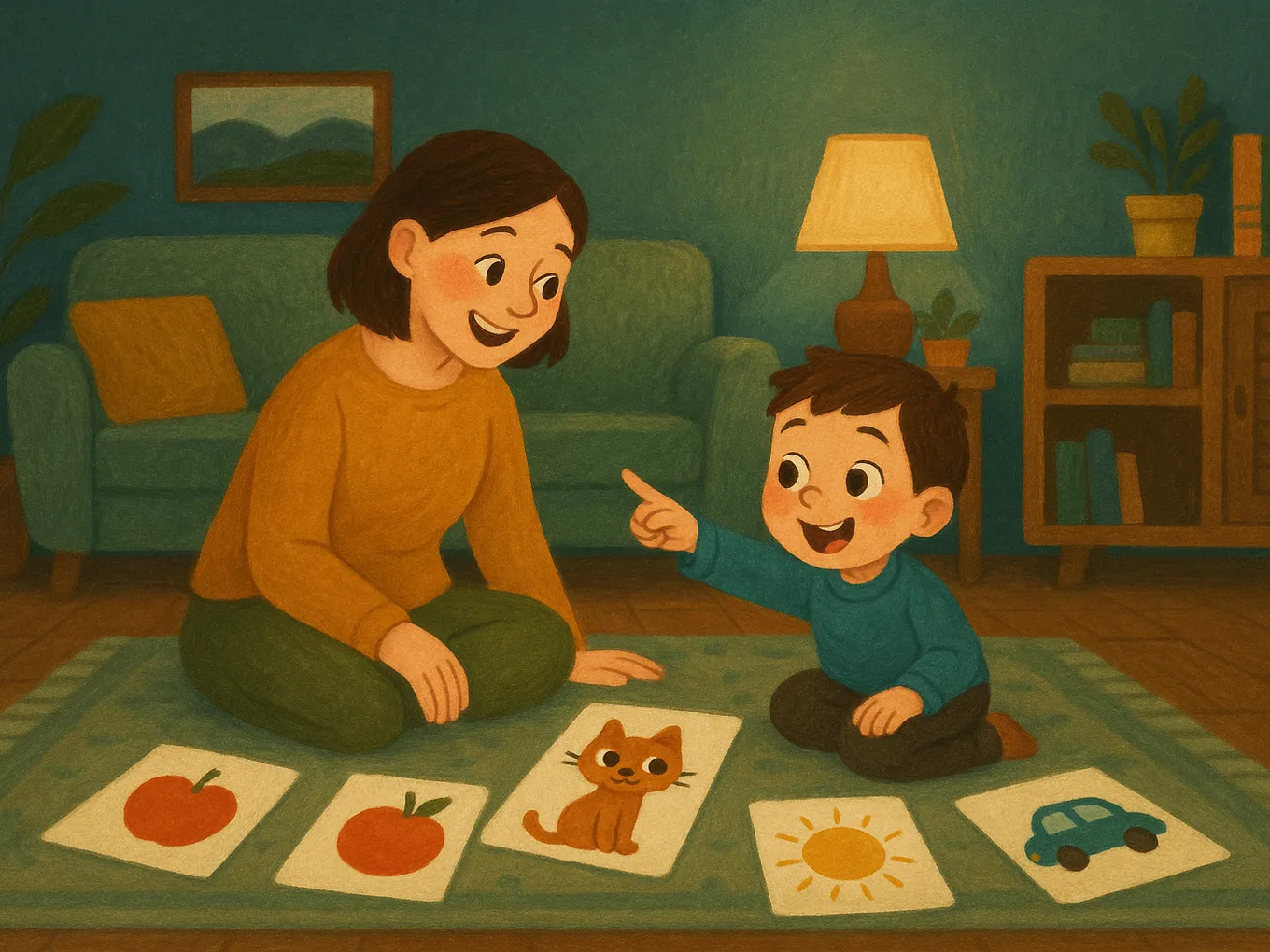
- “Show me!” (Point to...). “Point to the cat!” — the child points to the card. Then you switch roles, and you “make mistakes.”
- “What is missing?”. The child closes their eyes, you hide a card, and they name the missing one in English.
- Simon Says. “Simon says: jump!” — we do it; without “Simon says” — we stand still. Verbs stick through the body.
- “Color hunt”. “Find something red!” — the child looks for a red object, at home or on a walk.
- A song with movements. One per week — by the end of the week the child is singing on their own.
Two dozen more games are in the selection games for learning English with a child.
The first month plan
5–6 sessions a week, 10–15 minutes each: a little every day is better than two one-hour sessions.
| Week | Topic | Activities |
|---|---|---|
| 1 | Colors (red, blue, green, yellow, pink, black, white) | Color song; “Color hunt” every day; cards; on walks you name the colors of cars. |
| 2 | Numbers 1–10 | The song “Ten in the Bed”; count steps and toys; “Show the number”; combine with colors: “two red cars”. |
| 3 | Animals (cat, dog, bear, lion, fish, bird, mouse, frog) | The song “Old MacDonald”; “What is missing?” with figurines; “How does a cat go?”; a 5–7 minute cartoon about animals. |
| 4 | Action commands (run, jump, sleep, eat, stop, go) + review | Simon Says every day; an action song (walk, run, jump); review all cards with “Show me!”; first phrase: “It is a...”. |
To be honest: most families keep such a plan on the fridge for a week or two, and then “let’s skip today” becomes the norm. So it’s best to give the daily part, if your child has their own iPhone, to Mova: the lesson waits for them every day, words come back for review without your journal, and screen-time minutes for cartoons are counted automatically — you don’t have to count or remind anything. Your job is just to sit beside them for 10 minutes. The card games stay yours.
A 5–10 minute cartoon 2–3 times a week is also a lesson (what to watch — cartoons in English for children), but within the preschool screen-time limit. It’s hard to track that limit manually; in Mova, videos and games on the child’s phone are locked and open only for the minutes earned by the lesson — and you decide how many minutes the lesson gives. You can’t manually add “one more episode” there, even if you really want to give in in the evening: only the lesson gives minutes, so there’s no one to bargain with.
English kindergarten, lessons at home, or Mova
| Kindergarten / club | At home with parents | Mova | |
|---|---|---|---|
| Frequency | 2–3 times a week for 25–30 min | Every day for 10–15 min | A lesson every day |
| Strength | Group, games with peers, teacher’s pronunciation | The language is woven into daily life: breakfast, getting dressed, a walk | Consistency without reminders: words return for review until they stick, and the level adjusts automatically |
| Weakness | 10+ children — little speaking time for each | Parents need discipline and basic pronunciation | iPhone only; no live play or in-person explanations; at ages 5–6, an adult is needed nearby |
| Price | Approximately 800–2000 UAH/month (2026) | Free or the cost of cards | You can start for free |
The best option is a combination: a club gives structure, home gives real interaction, and the daily lesson gives consistency. Of these three, consistency is what usually falls away first, so it makes sense to give it to something that doesn’t get tired: in Mova, the daily lesson is there even when the club is on vacation and you’re overloaded at work. Worried about your own pronunciation — English with a child at home without knowing the language.
How Mova works for preschoolers
- Starts with the simplest material. No placement test: younger children begin with to be and the easiest words, and the difficulty rises daily based on their results.
- You can listen, not read. The lesson text can be played aloud, and the child can answer by voice.
- Words don’t disappear. A correct answer sends the word back after 1, 3, 7, 14, or 30 days; a mistake brings it back again tomorrow.
- A cartoon as a reward. Games and videos on the child’s iPhone open for minutes earned in the lesson — no arguments and no counting on your part.
- Sign in without email. The child connects the phone with your code, and you can see progress in the web dashboard.
What it does not replace: playing with you. A lesson in Mova is designed so the child can complete it independently, and a five-year-old still does not read. So at ages 5–6 the lesson is done together: you sit beside them, show where to tap, and help with the answer. Independence comes closer to age 7.
English for children 7 and older: what changes
At 7, you can add reading in English (first phonics) and first writing exercises; at 8–10, short rule explanations and words with review. Here Mova handles the daily part: 6 words and one rule, then a short test, and the child can already do it on their own. The play stays, but it becomes more advanced: board games, quests, comics. Age-based roadmap — English for children: where to start.
And for a teenager starting from zero: what changes
A 12–16-year-old needs a fast start with grammar (to be, Present Simple — within weeks), vocabulary from their world, and a clear goal. From zero to A2, a teenager can get there in 12–18 months of regular practice; in Mova, teenagers reach Present Perfect and B1-level vocabulary.
Mistakes parents of preschoolers make
- Demanding translation: “How do you say ‘table’?” Speed quizzes kill interest within a week.
- Sitting them down with handwriting sheets and a textbook. Writing comes after age 7; at 5–6 it will only bring tears.
- Correcting every mistake. She said “I like cat” — great. Just rephrase it correctly: “Oh, you like the cat!”
- Doing it in bursts: one month every day — then three months of nothing. Without review, words disappear in a few weeks. This is exactly where home plans break: they start with enthusiasm, and a month later no one remembers anything. In Mova, the daily lesson and word review happen automatically, because the cartoon opens only after the lesson, and for every 5 consecutive days the child also gets bonus minutes.
- Expecting quick results. In the first months the child listens and stays quiet — that’s a normal “silent period.”
Frequently asked questions
At what age should we start — 5 or 6?
Readiness matters more: can the child handle 10–15 minutes of play by the rules, and do they speak Ukrainian clearly? If you start at 6, you won’t lose anything; the material will sink in faster.
What materials do I need for a preschooler’s lessons?
Themed cards, simple songs with movements, and short cartoons in English. Textbooks and handwriting books are not needed — the child still isn’t reading even in Ukrainian.
How many words should a preschool child know?
Over a year of playful lessons — 100–200 words by ear and in speech: colors, numbers, animals, food, family, simple verbs. This is recognizing and naming, not reading.
Is Mova suitable for preschoolers?
Yes, from age 5 if the child has an iPhone: younger children start with to be and the simplest words, lesson text can be listened to, and answers can be spoken. But at ages 5–6, the lesson is done together with a parent, and it complements playing with you: Mova provides daily consistency and word review, not live play.
Will English harm my child’s Ukrainian?
No, if Ukrainian is already established. Mixing words (“дай мені apple”) is a normal stage. If there are speech-therapy issues in the native language, start with a speech therapist first.
What should I do if my child refuses to study?
Don’t force it: refusal means the format is boring or too long. Shorten the lesson to 5–7 minutes, remove the word “lesson,” and start with a favorite topic.
Want English to be part of your child’s day every day, not in bursts, and for you not to have to count or remind them? Try Mova for free.
Also read: