The verb to be for kids: an explanation with exercises
The verb to be means “to be” and in the present tense it has three forms: am, is, are. In Ukrainian we can say “I am a pupil” without the verb, but in English you can’t leave it out: I am a pupil.

Roman Shkabko · 8 min read
The forms of the verb to be in English — all in one table:
| Form | Used with | Example | Translation |
|---|---|---|---|
| am | only I | I am seven. | I am seven years old. |
| is | he, she, it (one) | She is my sister. | She is my sister. |
| are | you, we, they (plural, and always you) | We are at home. | We are at home. |
When we use to be: three situations
To be is needed when we are not talking about an action, but about a state:
- Who I am / who it is. I am Olia. He is a doctor. It is a dog.
- What someone or something is like. She is happy. The ball is red. They are tired.
- Where someone or something is. We are at home. The cat is under the table.
The main rule: if there is no other verb in the sentence, use to be. “I am happy” — I am happy. “I play football” — the action is already there: I play football.
The to be table with pronouns and contractions
Learn the contractions right away — that’s how they sound in cartoons and everyday speech.
| Pronoun | Form | Contraction | Example |
|---|---|---|---|
| I | am | I'm | I'm eight. |
| You | are | You're | You're my friend. |
| He | is | He's | He's tall. |
| She | is | She's | She's at school. |
| It | is | It's | It's a cat. |
| We | are | We're | We're hungry. |
| They | are | They're | They're in the park. |
Tip: English treats you with respect, so you always use are with you, even when it means just one “you”.
Negatives and questions with to be
No do/does here: for the negative, add not after the form; for a question, move the form to the beginning.
Negatives
| Full form | Contraction | Example |
|---|---|---|
| I am not | I'm not | I'm not tired. |
| He / she / it is not | isn't | He isn't at home. |
| You / we / they are not | aren't | They aren't ready. |
Questions
| Affirmative | Question | Short answer |
|---|---|---|
| You are hungry. | Are you hungry? | Yes, I am. / No, I'm not. |
| She is your sister. | Is she your sister? | Yes, she is. / No, she isn't. |
| They are at school. | Are they at school? | Yes, they are. / No, they aren't. |
“The jump”: She is happy → Is she happy?
The verb to be in Past Simple: was and were
In the past tense, there are only two forms:
| Pronoun | Form | Example | Translation |
|---|---|---|---|
| I, he, she, it | was | I was at school yesterday. | I was at school yesterday. |
| You, we, they | were | We were happy. | We were happy. |
is → was, are → were, and am also becomes was. Negatives and questions work the same way as in the present: I wasn't scared. Were you at home?
To be is one of the most common irregular verbs.
How to explain to be to a child aged 6–8
Games and rhythm work better than a lecture:
- The “I’m a to be robot” game. The robot speaks only in sentences with am/is/are. Point to yourself, to the child, to the cat — and the robot “voices” it: I am a robot. You are Mum. It is a cat.
- Match cards. Pairs like “pronoun + form”: I + am, he + is, we + are. Hands remember pairs faster than eyes remember a table.
- A chain song. “I am, you are, he-she-it is, we are, they are” to any tune. Twenty seconds a day — and in a week it sticks like glue.
- Sentences about their own life. I am Marko. My cat is black. We are in the kitchen. Children are more willing to talk about themselves.
- Come back to it after a few days. A topic stays only when you return to it. This is where home plans often fall apart: the cards and the song last a week, and then nobody remembers them. That’s why it’s best to leave the repetition to Mova: the rule and the words show up in the daily lesson on their own until they’re learned, and you don’t have to remind or track anything.
For preschoolers, use ready-made phrases from songs, without tables (English for preschoolers). If letters are confusing, start with phonics.
How Mova trains to be every day
- To be is among the first rules. Younger children start with it and the simplest words; there is no entry test, and the level adjusts every day.
- The rule is built into the lesson. In the Words & Grammar part, there are 6 words and 1 rule, then a short test. If they don’t pass, there’s another try an hour later with different questions.
- Words come back on a schedule. A correct answer means the word returns after 1, 3, 7, 14, 30 days; a mistake means tomorrow.
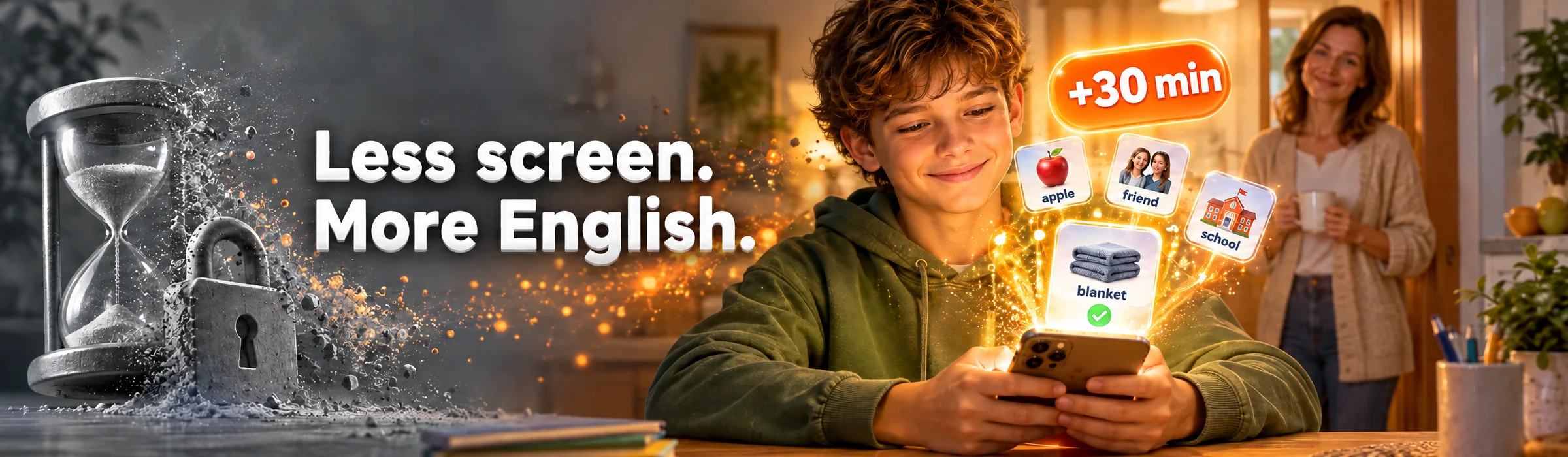
- Nothing has to be counted. Games, social media, and videos on the child’s iPhone are locked and only open for the minutes earned through lessons: a “Super” test gives 30 minutes, “Good” gives 20, and if all tests for the day are “Super,” that’s another +10. The minutes are added automatically, so you don’t need to sit beside them and keep a chart.
- The streak keeps the rhythm going. Every 5 days in a row without missing a lesson brings bonus minutes, so coming back every day is worth it for the child.
- You can see progress. In the dashboard, you’ll see the level, words they “know / are learning,” and each day’s result.
Mova doesn’t replace live explanation: games are still up to you, repetition is up to the lessons.
10 exercises on to be with answers
Do 3–4 exercises at a time and come back to them after a few days: a one-time approach blows away within a week.
Exercises 1–4. Fill in am, is or are
- I ___ seven years old.
- My dog ___ big and funny.
- We ___ in the park.
- You ___ my best friend.
Show answers
- I am seven years old.
- My dog is big and funny.
- We are in the park.
- You are my best friend.
Exercises 5–6. Fill in was or were
- Yesterday I ___ at school.
- My friends ___ in the yard.
Show answers
- Yesterday I was at school.
- My friends were in the yard.
Exercises 7–8. Find and correct the mistake
- He are my brother.
- I happy today.
Show answers
- He is my brother. (He is one, so use is.)
- I am happy today. (There is no other verb — am is needed.)
Exercises 9–10. Make sentences from the words
- is / cat / the / black
- you / are / hungry / ?
Show answers
- The cat is black.
- Are you hungry? (In a question, are comes first.)
Common mistakes Ukrainian children make
| Mistake | Correct | Why it happens |
|---|---|---|
| I happy. / She at home. | I am happy. She is at home. | A literal translation from Ukrainian. |
| He are, they is | He is, they are | Match cards and the song help. |
| I was, we was | I was, we were | Was “sticks” to everything. Remind them: are → were. |
| I am play football. | I play football. | One sentence — one verb. |
The boundary “to be — for states, do/does — for actions” is worth reinforcing before Present Simple.
Frequently asked questions
Why does English have three forms of to be, while Ukrainian has none?
In Ukrainian, “to be” is usually omitted in the present tense: “I am a pupil” is just “I a pupil.” In English, a sentence without a verb is a mistake, so the form changes depending on who is speaking: I am, he is, we are.
When is to be not needed in a sentence?
When the sentence already has an action verb: I play football, She reads books. The mistake “I am play football” appears when to be is added “just in case.” Rule: one normal sentence — one verb.
At what age should children learn the verb to be?
As a grammar topic with tables — from age 6–7, when a child can read short words. Preschoolers remember ready-made phrases like I am five, It is a cat through songs and games. In Mova, to be is one of the first rules for younger children, from age 5.
How long does it take for a child to learn to be?
With short daily lessons, am/is/are usually sticks in one to two weeks, and was/were in another week. Consistency matters more than lesson length. In Mova, there is a lesson every day, and the difficulty adjusts to the result: while to be is still hard, the child keeps practicing it.
Want am/is/are to be repeated every day without your reminders? Try Mova for free.
Also read: