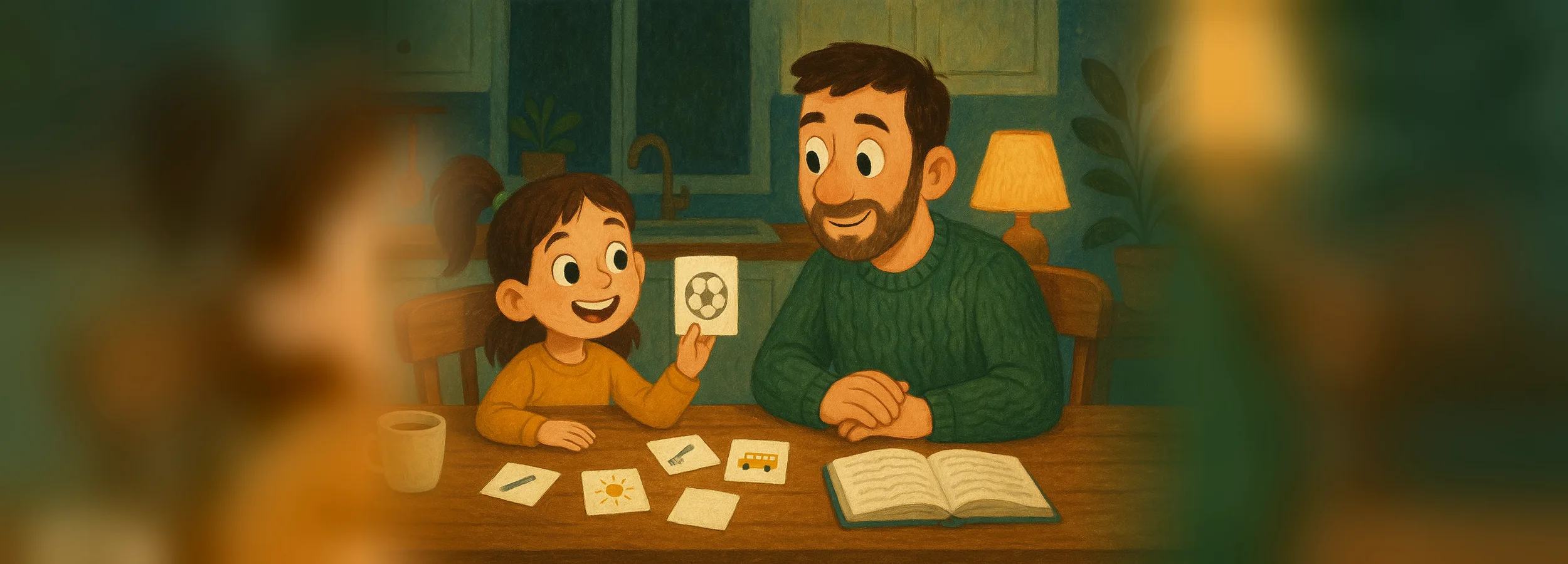
Present Simple in Simple Terms
Present Simple is the tense for regular actions and facts that are always true: I go to school every day. The sun rises in the east. Formula: subject + verb in the base form (V1), and for he/she/it add -s: She plays tennis.

Roman Shkabko · 9 min read
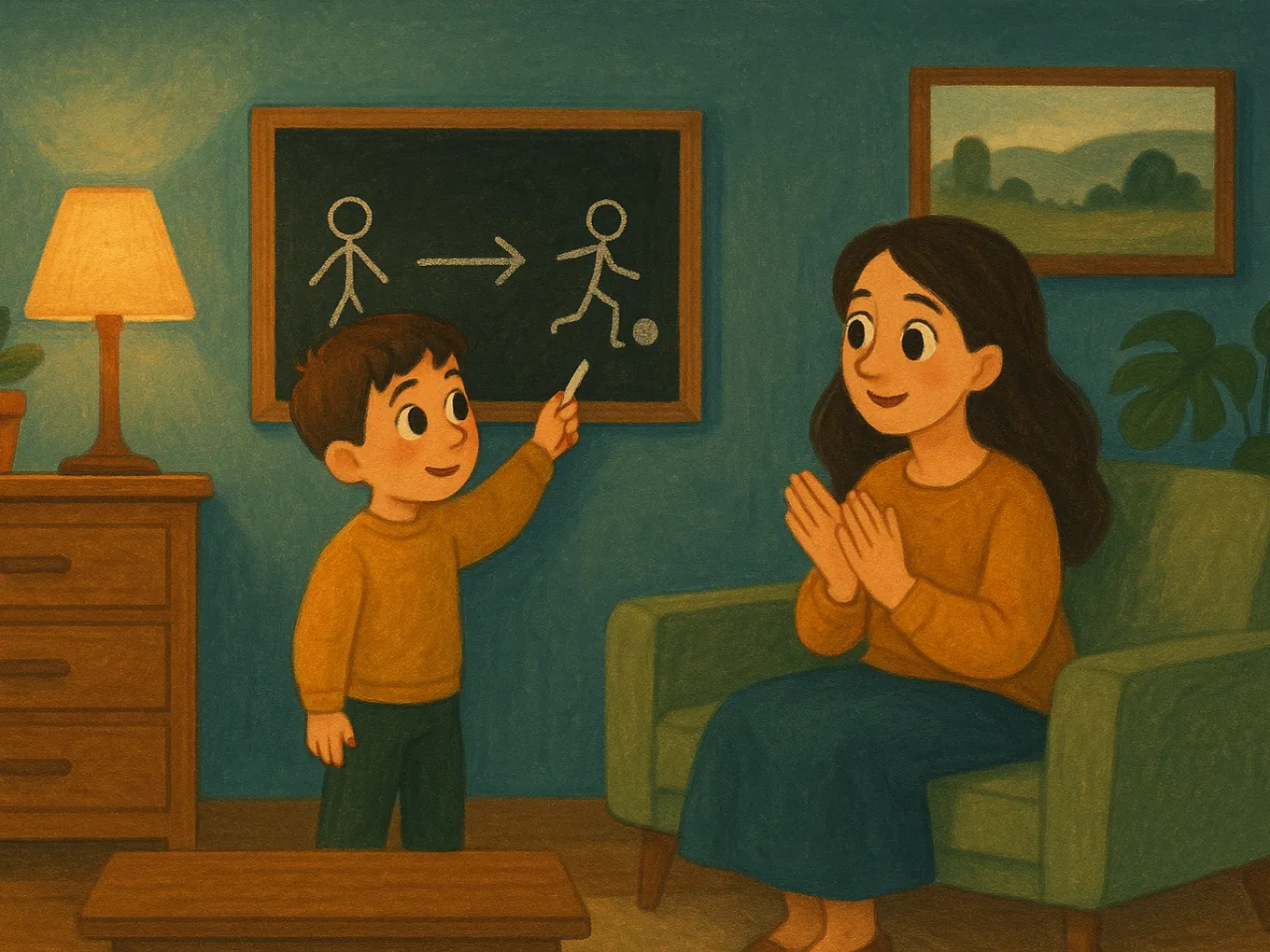
When we use Present Simple
- Habits and regular actions: I brush my teeth every morning. He plays football on Sundays.
- Schedules: School starts at 8:30. The bus leaves at 7:15.
- Facts and laws of nature: Water boils at 100 degrees. Cats don't like water.
- Feelings, thoughts, states — like, love, want, know, understand: I like pizza. She knows the answer.
I read books means “I generally read books,” not “right now”: for that, there is Present Continuous.
Affirmative sentences: formula and the -s ending
The verb is taken from the dictionary without changes, except with he, she, it:
| Pronoun | Example |
|---|---|
| I | I play chess. |
| You | You play chess. |
| We | We play chess. |
| They | They play chess. |
| He / She / It | He plays chess. |
- -s — with most verbs: play → plays, run → runs, like → likes;
- -es — after -s, -ss, -sh, -ch, -x, -o: watch → watches, go → goes, wash → washes;
- -ies — after a consonant + y: study → studies, fly → flies. But play → plays: there is a vowel before y.
Negatives: don't and doesn't
You need an auxiliary: doesn't — for he/she/it, don't — for everyone else.
| Pronoun | Negative | Example |
|---|---|---|
| I / You / We / They | don't + V1 | They don't watch TV. |
| He / She / It | doesn't + V1 | She doesn't watch TV. |
Questions: Do and Does
The same auxiliaries move to the first place:
- Do + I/you/we/they + V1: Do you like ice cream?
- Does + he/she/it + V1: Does he go to school? (no -s after does)
The short answer repeats the auxiliary:
| Question | Yes | No |
|---|---|---|
| Do you play tennis? | Yes, I do. | No, I don't. |
| Does she like math? | Yes, she does. | No, she doesn't. |
| Do they live here? | Yes, they do. | No, they don't. |
Question words go before do/does: Where does he live? What do you want?
To be and have in Present Simple
To be: am, is, are — without do/does
To be has its own forms and makes negatives and questions on its own:
| Pronoun | Affirmative | Negative | Question |
|---|---|---|---|
| I | I am ten. | I am not tired. | Am I right? |
| He / She / It | He is at school. | He isn't at home. | Is he at school? |
| You / We / They | They are friends. | They aren't ready. | Are they friends? |
Compare: Does he play?, but Is he a student? If your child is confused specifically by am/is/are, first go through the verb to be with exercises.
Have and has
Have behaves like a regular verb, except with he/she/it — has:
| Pronoun | Affirmative | Negative | Question |
|---|---|---|---|
| I / You / We / They | I have a dog. | I don't have a cat. | Do you have a pet? |
| He / She / It | She has a dog. | She doesn't have a cat. | Does she have a pet? |
After don't/doesn't and do/does — always have, never has.
Signal words for Present Simple
| Marker | Translation | Example |
|---|---|---|
| always | always | She always gets up at 7. |
| usually | usually | I usually walk to school. |
| often | often | We often play outside. |
| sometimes | sometimes | He sometimes helps me. |
| never | never | They never eat fish. |
| every day / week | every day / every week | I read every day. |
| on Mondays | on Mondays | We have PE on Mondays. |
Always, usually, sometimes, never come before the main verb, but after to be: He always plays, but He is always late. “Every day” and “on Mondays” go at the end of the sentence.
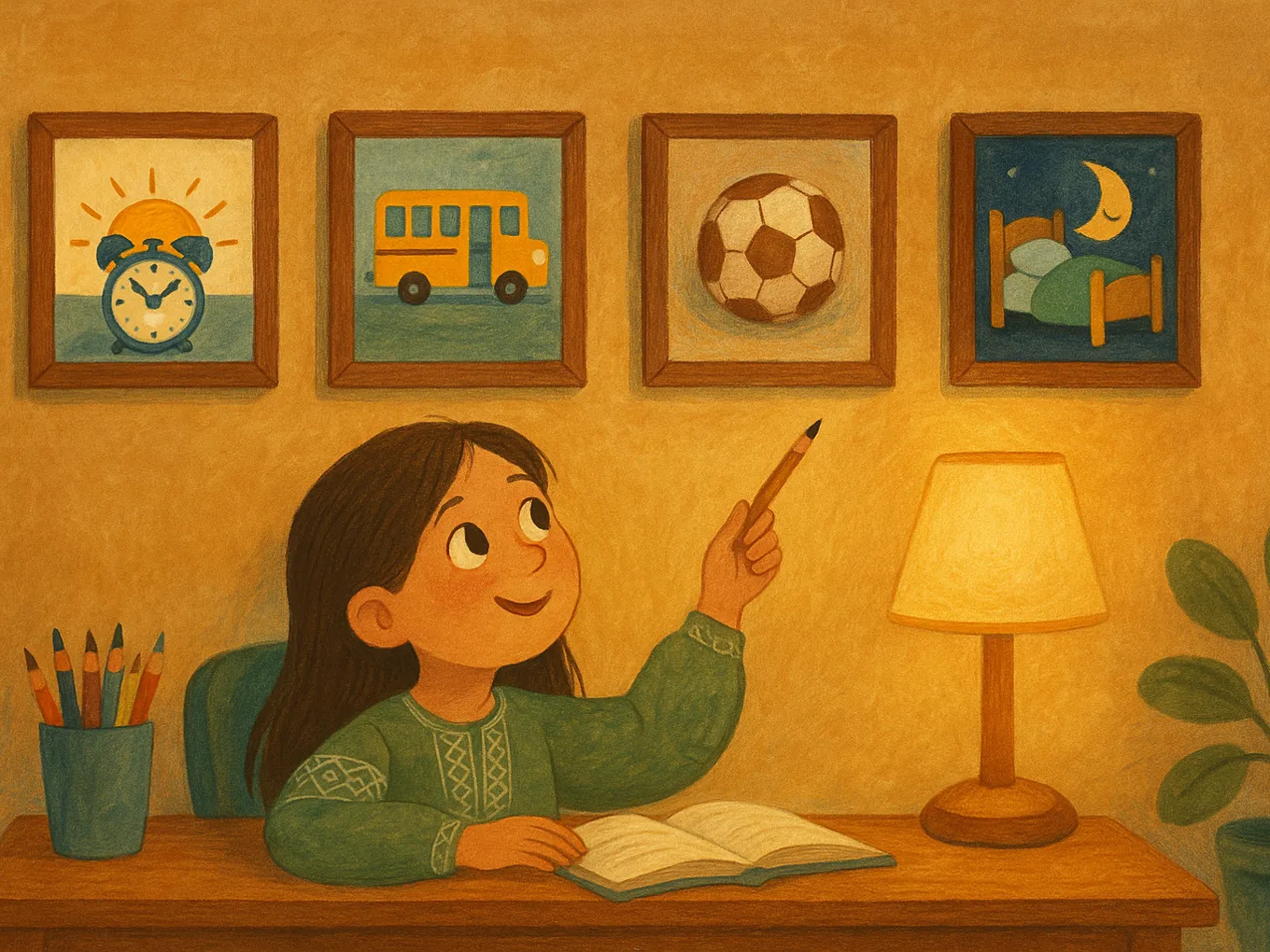
How to explain Present Simple to a child aged 8–10
The “daily schedule” analogy
Present Simple is the “schedule tense”: waking up at 7:00, school at 8:30, practice on Tuesdays. Ask your child to tell you about their day: I get up at 7. I go to school. I play with my dog. Each item is a complete sentence. And he, she, and it are “special guests” who always bring the -s ending.
Charades game
One person acts out a habit without words, and the others guess in a full sentence: You brush your teeth! He plays football! A harder version is to guess using questions like Do you…? Does she…? and answer Yes, I do / No, I don't.
The -s ending becomes automatic through repetition, and the hardest part is consistency, especially when there’s a phone with games nearby. The “10 sentences a day” chart on the fridge usually disappears after a week: parents don’t have time to check, and the child has no reason to keep it up. That’s why it’s easiest to hand over the daily part to Mova: one lesson with a rule every day, screen minutes are counted automatically, and games on the iPhone open only for earned time — so nobody has to check the chart anymore. How to turn learning into a habit is covered in the article the 15-minute independent study habit.
Present Simple in Mova
- The rule of the day in the lesson. Words & Grammar — 6 words and 1 rule, then a short test.
- Level without a placement test. Difficulty adjusts every day based on results: from to be for younger children to Present Perfect for teens.
- Words with repetition. A correct answer means the word returns after 1, 3, 7, 14, 30 days; a mistake means tomorrow.
- Reading with questions. Read & Write — a text and questions, with answers typed or spoken: grammar in real sentences.
- The screen is the reward. The child’s iPhone games, social media, and videos are locked and open with earned minutes: “Super” — 30, “Good” — 20, all the day’s tests at “Super” — another +10. Didn’t pass — try again in an hour with different questions.
- No counting needed. Minutes are added automatically, and you can see your child’s progress in the web dashboard. Test rewards can be changed or turned off there too.
Mova can’t explain things live — the analogies and games are up to you.
10 exercises with answers
In 1–3, put the verb in the correct form. Answers are hidden.
- She ___ (play) the piano.
- My brother ___ (watch) cartoons every evening.
- I ___ (go) to school by bus.
- Negative: He likes coffee.
- Negative: They live in Kyiv.
- Question: She speaks English.
- Short answer “no”: Does your dad work on Saturdays?
- Choose am/is/are: My friends ___ at the park.
- Choose have/has: My sister ___ a new phone.
- Correct the mistake: Does she plays tennis every day?
Show answers
- She plays the piano.
- My brother watches cartoons every evening. (after -ch → -es)
- I go to school by bus. (I — no ending)
- He doesn't like coffee.
- They don't live in Kyiv.
- Does she speak English?
- No, he doesn't.
- My friends are at the park.
- My sister has a new phone.
- Does she play tennis every day? (after does — no -s)
Common mistakes made by Ukrainian schoolchildren
| Mistake | Correct | Why |
|---|---|---|
| ❌ He doesn't plays | ✅ He doesn't play | -s is already “sitting” in does |
| ❌ He play football | ✅ He plays football | he/she/it in the affirmative always takes -s |
| ❌ Do she like it? | ✅ Does she like it? | she is third person, so the auxiliary is does |
| ❌ I am play tennis | ✅ I play tennis | am/is/are are not needed with a regular verb |
| ❌ She doesn't has a pen | ✅ She doesn't have a pen | after doesn't, use the base form, have |
| ❌ He always is late | ✅ He is always late | the adverb of frequency goes after to be |
“I am play” is a literal translation of “я є граю”; it’s cured by daily practice — exactly the kind Mova doesn’t need you to remind a child about: without the lesson, the games simply won’t open. Next: Present Perfect in simple terms, and in parallel it’s worth gradually learning irregular verbs.
Frequently asked questions
What is Present Simple in simple terms?
It is the tense for regular actions and facts that are always true: I go to school every day. Water boils at 100 degrees. Formula: subject + the base form of the verb, and for he/she/it add -s.
When do we add -s, -es, and when -ies?
Only for he, she, it in the affirmative. Usually add -s (plays). After -s, -ss, -sh, -ch, -x, -o — add -es (watches, goes). Consonant + y: y changes to i and -es is added (study — studies).
Why can't we say doesn't plays?
Because there can be only one -s in the sentence, and does has already taken it. After doesn't and does, the verb is always in the base form: He doesn't play. Does she like? This is the most common mistake schoolchildren make.
Have or has — how do I choose?
Has — only with he, she, it: She has a cat. With other subjects — have. After don't/doesn't and do/does, always use have: He doesn't have a bike.
How long does it take for a child to learn Present Simple?
The rule can be explained in one evening, but automatic use usually takes 2–3 weeks of short daily practice. You can hand over the daily part to Mova: the child’s phone opens only after a lesson with a rule and a test.
Want Present Simple to be practiced every day, with screen time as a reward rather than a reason to argue? Try Mova for free.
Read also: