How to Teach Your Child to Read in English (Phonics in Simple Terms)
The main rule: don’t teach letter names — teach sounds. A child who knows that s says “s,” not “ess,” can blend sat within a week. The sequence is: sounds → blending into words → simple words like cat and pin → common exception words (sight words) → first books. That’s the phonics method used to teach reading in British and American schools.

Roman Shkabko · 9 min read
Why reading in English is harder than in Ukrainian
In Ukrainian, letter ≈ sound: you see «м» and say “m.” In English, not so:
- 26 letters represent about 44 sounds, so many sounds are written with combinations: sh, th, ee — one sound made from two letters;
- the same letter can be read differently: a in cat, cake, and car — three different sounds;
- some of the most common words don’t follow the rules: the, said, one, was simply have to be memorized.
So “learn the alphabet and start reading” doesn’t work here. You need a system.
What phonics is: how English-speaking children are taught to read
Children are shown not the names of letters, but the sounds those letters represent — and are immediately taught to blend them into words. They see c-a-t → say the sounds → blend them into cat → understand that it means a cat.
Sounds are introduced from the most useful to the less common ones, and at every stage the child is already reading something independently — first words in 2–3 weeks. It’s best to get pronunciation from audio, not from vague memories of school English.
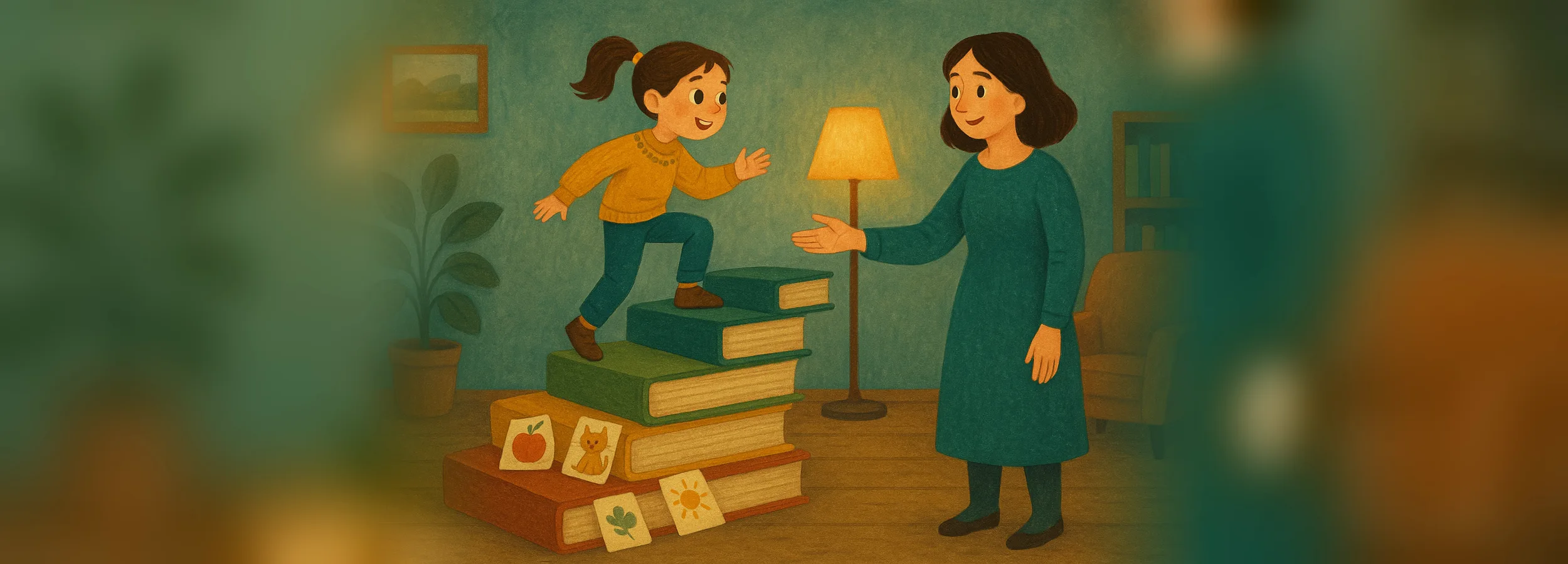
Step-by-step plan: from sounds to the first book
For a child aged 5–8, 10–15 minutes a day. If your child doesn’t know English words yet, build vocabulary in parallel — see the article on English for preschoolers aged 5–6.
Step 1. First sounds: s, a, t, p, i, n
Children don’t start with a, b, c, but with this set of six: it makes many real words — sat, pat, tap, pin, tin, nap, sip, pan. In the very first week, the child is already reading words and seeing the point of the lessons.
How to teach them: show the letter → play the sound → the child repeats → then look for the letter in words. 2–3 sounds a week, no more.
Step 2. Blending: reading CVC words
CVC means “consonant–vowel–consonant”: cat, sat, pin, dog, sun. Blending is the core skill in phonics. The child runs a finger under the letters and stretches the sounds without pauses: not “c… a… t,” but one smooth blend into cat.
3–5 words per lesson is enough. Then add the remaining sounds: m, d, g, o, c, k, e, u, r, h, b, f, l — and the number of readable words grows every week.
Step 3. Digraphs: two letters, one sound
Without them, a child can’t even read she or fish. The first five are:
| Digraph | How it sounds | Example words |
|---|---|---|
| sh | “sh” | she, fish, shop |
| ch | “ch” | chip, chat, lunch |
| th | an interdental sound, with the tongue between the teeth (voiced in this, unvoiced in thin) | this, then, thin, bath |
| ee | long “ee” | see, tree, feet |
| oo | “oo” (short in book, long in moon) | book, look, moon, food |
One digraph, a few days of practice with real words — then move on to the next.
Step 4. Sight words: words children should just recognize
The most frequent words that don’t follow phonics rules are learned as whole words, “by sight.” Here are the first 20, found in almost every children’s book:
the, I, a, to, said, and, is, it, in, he, she, we, no, go, my, you, was, of, look, are
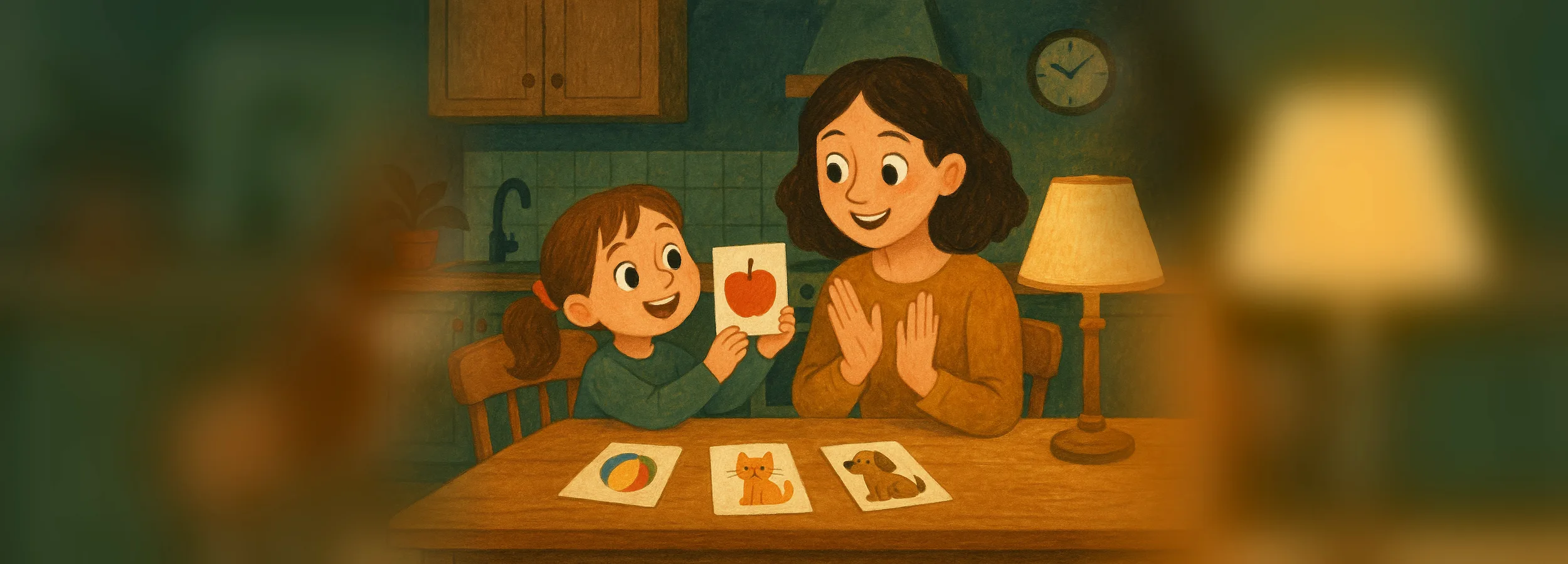
Use flashcards, introduce 3–4 new words a week, and keep reviewing the old ones. For themed vocabulary sets, see the article English words for children by topic.
The weak point of flashcards is review: in the first weeks, children go through them eagerly, then the box sits on a shelf and no one remembers which word was last seen when. In Mova, review is tracked automatically: every word comes back after 1, 3, 7, 14, and 30 days, and a forgotten word returns the very next day.
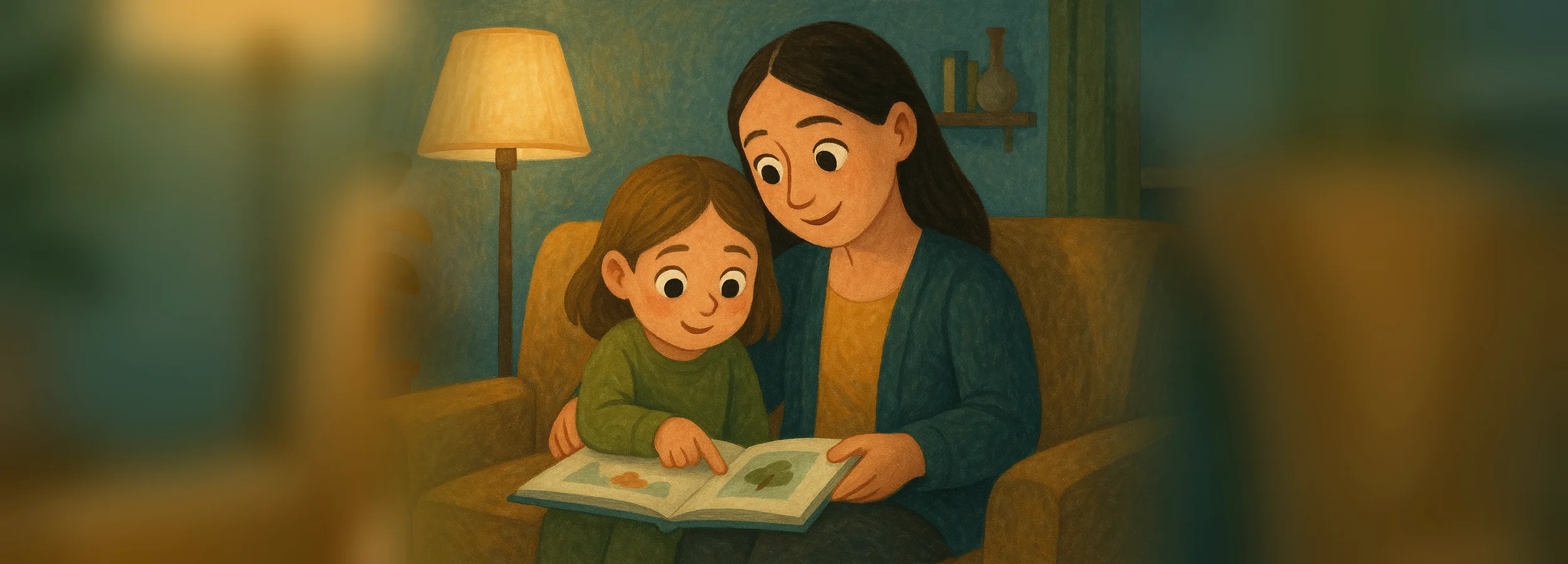
Step 5. First books: decodable books and graded readers
When a child can blend CVC words, knows the first digraphs, and recognizes 15–20 sight words, it’s time for books — but the right kind:
- Decodable books — written using only the sounds the child has already learned. Search for them by this exact name; many are available free in publishers’ digital libraries.
- Graded readers — levelled books with simplified vocabulary, for the next stage.
Regular books “for native speakers” can actually do harm at this stage: the child keeps stumbling over words that don’t fit the rules and decides they “just can’t read.”
How long it takes to teach a child to read in English
Realistically, 6–12 months at 10–15 minutes a day:
- Weeks 1–4: the first 6–10 sounds, first blending attempts, 10–20 CVC words.
- Months 2–3: all basic sounds, confident blending, first sight words.
- Months 3–6: digraphs, 20–40 sight words, first decodable books.
- Months 6–12: more complex letter patterns (ai, oa, igh, magic e as in cake), graded readers, independent reading of short books.
The key is consistency: blending is like riding a bike — it develops through frequent short practice sessions. For ideas on how not to skip days, see the article the 15-minutes-a-day habit.
And consistency is usually exactly what breaks down: the first week you sit down together, then it becomes “we’re too tired today” and “we’ll catch up tomorrow.” Once a child can already blend words, daily reading can be handed over to Mova: every day there’s a short text and questions to go with it, while games and videos on the iPhone unlock only for minutes earned by completing the lesson. No reminders or negotiations needed — no lesson, no minutes.
Common mistakes parents make
- Learning the alphabet song and expecting reading to follow. The ABC song teaches letter names, but reading requires sounds. The alphabet will be useful later — for dictionary skills and spelling; see more in the article on the English alphabet for children.
- Writing pronunciations in Ukrainian letters. If you write “ket” under cat, the child reads your prompt, not the English word. Remove the prompt — and the reading disappears.
- Forcing the child to read aloud before they’re ready. Until blending really clicks, it’s stressful. Start with whispering; reading aloud can come when the child wants to.
- Skipping levels. A “real” thick book in the second month is a reliable way to kill motivation. The text should be 90–95% familiar.
Free resources for phonics
Sounds are best introduced through cartoons where letter-characters blend into words, and interactive websites with audio: click on a letter, hear the sound. Decodable books can be found in publishers’ digital libraries. For cartoons matched to your child’s level, see the collection cartoons in English by levels A1–B1.
Where Mova fits in: once your child can already blend words
Phonics teaches decoding, but to understand what they read, children also need vocabulary and daily texts at the right level. Parents usually manage the schedule, flashcards, and “Did you read today?” for the first two weeks — and then everything quietly stops. Mova takes over from there:
- A text every day. Every lesson includes a short text the child reads or listens to, plus questions. That’s the daily reading practice.
- Words for understanding. New words and one grammar point in every lesson, with review after 1, 3, 7, 14, and 30 days.
- The level adjusts automatically, with no placement test: younger children start with the simplest words.
- Daily practice without nagging. Games, social media, and videos on the child’s iPhone stay locked and open only for minutes earned through the lesson: “Super” on the quiz gives 30 minutes, “Good” gives 20. You don’t have to count anything — you can see each day’s result in the web dashboard.
What it doesn’t do: it doesn’t teach sounds from scratch — steps 1–3 are still up to you and your cards. And it works only on iPhone.
Frequently asked questions
At what age should I teach my child to read in English?
Ideally at 5–7, when the child already knows Ukrainian letters and understands that a symbol represents a sound. You can start earlier too, but progress will be slower and more game-based.
Do children need to learn the English alphabet first?
No. Letter names (ay, bee, see) get in the way of reading: the child sees cat and reads “cee-ay-tee.” First come sounds; letter names will be useful later for spelling.
Can I teach my child to read in English if I don’t know the language myself?
Yes. The phonics sequence is well established, and pronunciation comes from videos and websites with audio. Your role is to spend 10–15 minutes alongside your child and praise their effort. And once they can already blend words, Mova can take over daily texts with audio and word review.
What are sight words, and how many does a child need to know?
They’re common words that don’t follow the rules (the, said, one) and are best recognized instantly. For first books, 20–40 is enough; by the end of the first year, around 100.
Is phonetic transcription necessary for reading in English?
At the beginning, no: a child aged 5–8 connects letters and sounds directly through phonics. Transcription is worth introducing around age 9–10, together with dictionary skills.
My child can sound out a word letter by letter, but can’t blend it together. What should I do?
That’s a normal stage. Stretch the word without pauses: not “c… a… t,” but one smooth blend into cat, gradually faster. 3–5 words a day is usually enough for blending to click within 2–4 weeks.
Want your child to read in English every day without your reminders? Try Mova for free.
Read also: