

How to Wean Your Child Off Their Phone: Signs of Addiction and a No-Drama Plan
Taking the phone away abruptly isn’t a solution — it’s the start of a war: meltdowns, lying, and sneaking games on other people’s devices. What works is something else: a 2–4 week plan where you first measure actual screen time, then introduce rules and phone-free zones, and gradually turn screen time into a reward after responsibilities are done, not the background of everyday life. Below you’ll find a checklist of addiction signs, markers that it’s time to see a specialist, the week-by-week plan, and a child phone agreement template.

Roman Shkabko · 12 min read
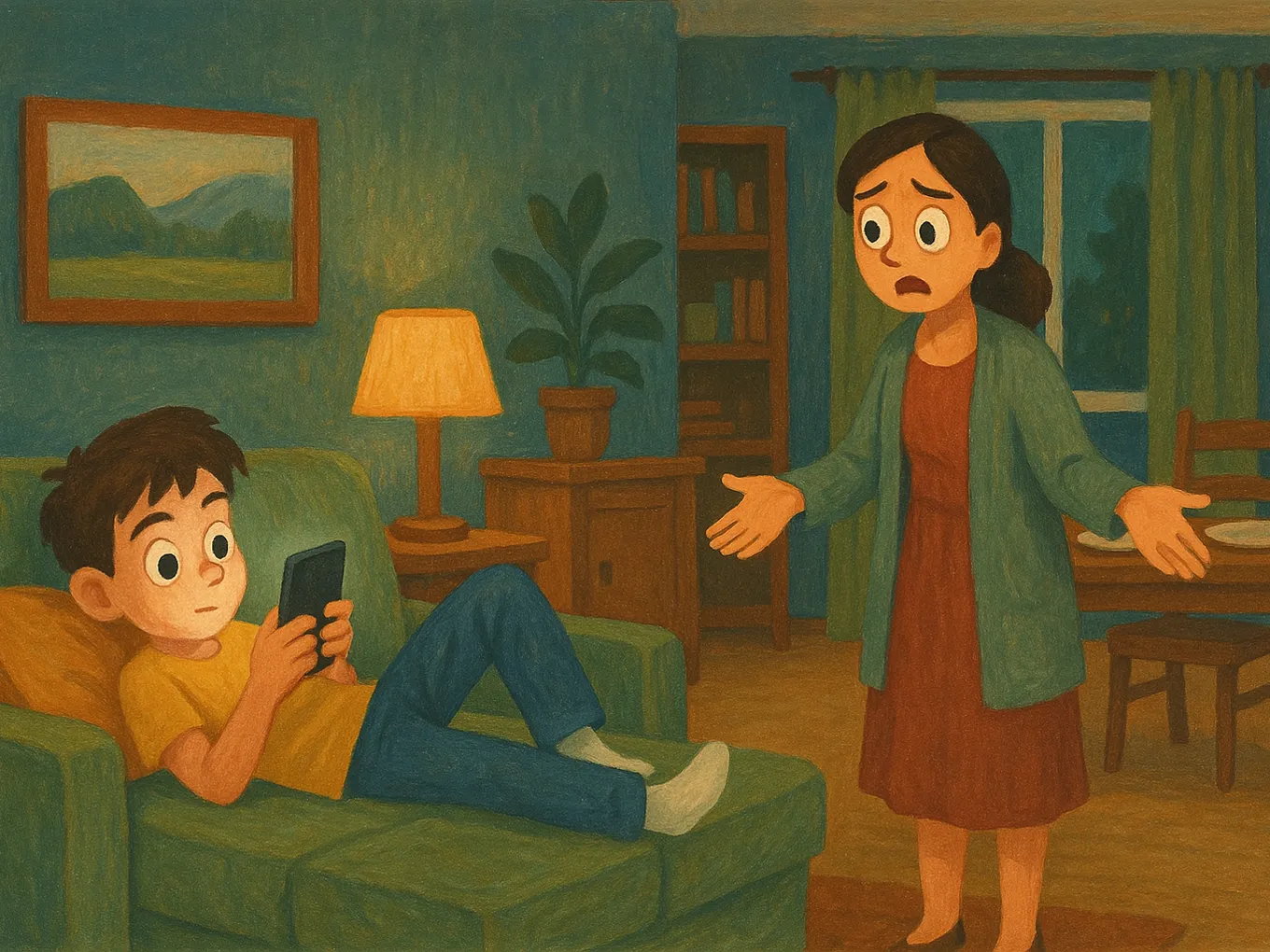
A familiar scene: “Just five more minutes!” — and an hour later, it’s still the same five minutes. “Mooom, I’m just finishing this round!” — and dinner is getting cold. You raise your voice, your child cries or slams the door, the phone gets confiscated, and the whole evening is ruined for everyone. The next day, the cycle repeats. If this sounds like your family, the problem isn’t your “weakness” or your child’s “bad attitude” — it’s the lack of a system.
Signs of phone addiction in children: a checklist
Phone addiction in children isn’t just “spending a lot of time on it” — it’s losing control over that time and reacting badly when it’s limited. We covered what counts as “normal” in our article on screen time guidelines by age. Here, though, is a checklist of specifically problematic behavior. Mark what applies:
- Meltdowns when it’s taken away. Your child has a meltdown when you take the phone away: yelling, tears, aggression — and it happens almost every time, not just once in a while.
- Abandoned hobbies. Sports, drawing, bike rides — anything they used to enjoy has been dropped, with nothing replacing it except screen time.
- Sleep problems. They stay up past midnight with the phone, struggle to wake up, and bring the device into bed (for how to remove gadgets before bedtime, see the separate article “Phone at Night”).
- Eating with the phone. They won’t sit down at the table without a screen, or they eat mechanically without looking away from a video.
- “Just 5 more minutes” never ends. Your child can’t stop on their own, and time agreements don’t work.
- The first and last thing every day. The phone is the first thing they pick up in the morning and the last thing they put down at night.
- Irritability without a screen. Without the phone, they’re bored, angry, and “don’t know what to do” even for 20–30 minutes.
- Lying and workarounds. They play in secret, look for ways around limits, and lie about homework being done so they can get screen time.
- School performance slipping. Grades got worse specifically during the period when screen time increased.
- Real-life interaction is losing. They turn down walks and meetups with friends in favor of games or scrolling.
0–3 matches: this is a typical age-related pull toward gadgets, and rules and limits are enough. 4–6: a habit has formed, and you need the plan from this article. 7+: pronounced gadget addiction — you still need the plan, but also read the next section.

When you need a specialist
Severe gaming addiction in children and teens is no longer just a matter of parenting rules — it’s something to work through with a child psychologist. Reach out if you see even one of these warning signs:
- aggression when screen time is limited becomes physical: your child hits things, raises a hand, or threatens you or themselves;
- refusing food, hygiene, or school for the sake of games goes on for days;
- sleeping less than 6–7 hours because of gaming is a pattern, and the child is secretly playing at night;
- signs of emotional distress: withdrawal, apathy when not on a screen, statements like “without the game my life is nothing”;
- money disappears into in-game purchases without permission, despite a ban;
- you followed the plan consistently for a month — and nothing changed.
Seeing a specialist doesn’t mean “handing your child over to doctors” — it’s a normal step, like going to the dentist for a toothache. Usually it starts with 1–2 consultations for the parents: often it’s the family rules that need adjusting, not the child that needs to be “treated.”
Why “just take the phone away” doesn’t work
Confiscation feels like the quickest fix, but it misses the mark for three reasons:
- It removes the symptom, not the cause. A child stays glued to a screen because it offers quick rewards, while outside the screen there’s emptiness: no hobbies, no company, no structure to the day. Take away the phone, and the emptiness remains — plus resentment.
- It damages trust. For a teenager, a phone is how they stay connected with friends. Taking it away means “cutting them off from their people,” and after that your child is at war with you, not with the habit: they play at friends’ houses, create secret accounts, and work around passwords.
- It doesn’t teach self-regulation. The goal isn’t a child without a phone, but a child who can put the phone down on their own. An outside ban doesn’t teach that: the moment control disappears (camp, sleepovers, getting older), screen time explodes.
That’s why addiction has to be addressed not with bans, but with a reset: the screen moves from “default background noise” to “limited pleasure after responsibilities.” That’s exactly what the plan below is designed to do.
A no-drama plan: 4 weeks

| Week | What you do | Result of this stage |
|---|---|---|
| 1. Measure and talk | Don’t ban anything yet. Check the Screen Time report: how many hours, which apps. Talk without blame: “Look, it’s 5 hours a day. Which of that actually matters to you?” | Honest numbers — and a child who isn’t defensive because nothing has been taken away. |
| 2. Rules and phone-free zones | Together, introduce 3–4 rules: no phones at the table, no phones for an hour before bed, no phones during homework. Everyone’s phones stay overnight outside the bedrooms — parents’ included. | The screen disappears from the day’s “critical” moments: meals, sleep, and learning. |
| 3. Screen time becomes a reward | The order of the day gets flipped: homework, responsibilities, a walk or an activity first — then free screen time within the limit. Entertainment categories open after things are done, not “until someone takes the phone away.” | Your child gets phone time predictably and without bargaining, and the “just 5 more minutes” negotiations start fading out. |
| 4. Lock it in | Sign an agreement (see the section below), note what worked, and relax anything that turned out to be too strict. Plan what will fill the “freed-up” part of the day. | The rules hold without daily reminders and shouting. |
Two important details. First: cut back gradually — you don’t go from 5 hours a day to 1 hour overnight; a realistic step is 30–60 minutes less per week. Second: the freed-up time needs to be filled with something, otherwise your child will just be bored and push back harder. For ideas, see our roundup on what to keep a school-age child busy with instead of a phone.
Practically speaking, it’s easier to keep limits not on trust alone but in the settings: on iPhone, that’s Settings → Screen Time (for step-by-step setup, see the guide on parental controls on iPhone). That way the “police officer” is the system, not you.
Or instead of manual limits, install Mova: games, social media, and video on your child’s iPhone are blocked, and your child earns screen minutes by completing a daily English lesson — 30 minutes for an “Excellent” test result, 20 for “Good.” Then week three of the plan — “screen after responsibilities” — no longer depends on your nerves: the rule works by itself every day, even when you forget about it. Screen Time still remains useful for the things Mova doesn’t handle: Family Sharing, Ask to Buy, content filters, and location sharing.
A phone agreement with your child
An agreement is simply the rules written down and signed by both sides. The magic isn’t in the paper itself, but in the process: your child helps create it, so the rules become “ours,” not “Mom’s.” With a teenager, very little works without an agreement at all. A 9-point structure:
- The parties. Who is making the agreement: child and parents, with names and signatures — the grown-up way.
- How much. The daily entertainment screen limit for weekdays and weekends (actual numbers, not “not too much”).
- When. The time windows when screens are allowed, and what has to be done first: homework, chores.
- Phone-free zones. The table, the bedroom after a set hour, homework time, family events.
- What is always allowed. Calling parents, maps, school apps — outside the limits, so the rules don’t feel like a total ban.
- Rules for parents. Yes, yours too: no scrolling during dinner, no poking at your phone while your child is talking to you. This is the strongest point in the whole agreement.
- What happens if the rules are broken. A specific, proportionate consequence: minus 30 minutes of screen time tomorrow. Not “a month without your phone.”
- What happens if the rules are followed. A bonus for a week with no violations: extra time on the weekend, a family trip to the movies.
- Reviewing the terms. A date when you revisit the agreement together (once every 1–2 months): your child is growing, so the rules should change too.
So you don’t have to build it from scratch, just copy these 9 points onto a sheet of paper, fill in the blanks together with your child, and stick it on the fridge. Honestly, after a couple of weeks, hardly anyone checks that sheet anymore. That’s why the most important point — “screen after responsibilities” — is better handed over to Mova: there, minutes are added and run out automatically, and nobody has to count anything.

What to do when your child has a meltdown without the phone
Meltdowns at the start of the plan are normal, not a sign that you’re failing: the brain is protesting the loss of familiar stimulation. Here’s the step-by-step approach in the moment of the blow-up:
- Don’t yank the phone away in the middle of the conflict. Pulling it out of their hands guarantees escalation. The rule applies from the next “session,” not through a physical victory.
- Give advance warning. “We’re turning it off in 10 minutes” works better than a sudden “that’s enough.” A kitchen timer works better than your voice: arguing with a timer is boring.
- Acknowledge the feeling without changing the rule. “I know it’s frustrating to stop in the middle of a game. And your time is up.” No lectures about the harms of screens — nobody can hear that right now.
- Don’t negotiate during the meltdown. Every bargained-for “just 5 more minutes” teaches one lesson: meltdowns work. A compromise is possible before the deadline (“finish the round, then we turn it off”), but not after the yelling starts.
- Offer a bridge. After they calm down, don’t leave a void — move to the next thing: dinner, a walk, doing something together. It’s easier to switch to “something” than to “nothing.”
- Debrief later. In the evening, calmly ask: what would help make it easier to stop tomorrow? Often the child suggests a workable solution themselves.
Most often, the blow-up happens at the exact moment the phone is taken away. With Mova, that moment doesn’t exist: earned minutes simply run out on their own, and your child earns new ones through an English lesson — so they’re no longer arguing with you, but with the balance.
Frequently asked questions
My child has a meltdown when I take the phone away. Is that already addiction?
One meltdown, no — that’s a normal reaction to being interrupted abruptly. The warning sign is when the meltdown happens every time, lasts longer than 20–30 minutes, and your child still doesn’t calm down even after a compromise. In that case, go through the checklist above: if 4 or more points match, start the weaning-off plan.
My child plays games all day. Should I take the phone away completely?
No. A total ban almost always backfires: your child keeps playing at friends’ houses, at school, or on other devices — just without your oversight. What works is gradual reduction: first measure the real amount of time, then set limits on the gaming category and clear windows when gaming is allowed.
How do I get a teen to give up the phone at night without a war?
Don’t “take it away” — agree on a rule for the whole family: all phones, including the parents’, spend the night charging in the kitchen. A rule that applies only to the teen feels like punishment; a shared rule feels like a normal household standard.
How long does it take to break phone dependence?
With the plan in this article, 2–4 weeks to get to a stable result: the first week is for measuring and talking, then come the rules, phone-free zones, and the “screen after responsibilities” system. After that, the rules still need support for another 1–2 months, otherwise the habit comes back.
Can phone addiction be handled without a psychologist?
In most cases, yes: everyday gadget dependence can be corrected with rules, an agreement, and replacing screen time with other activities over 2–4 weeks. A specialist is needed if you see the warning markers from the section above: aggression with threats, refusal to eat or go to school, signs of depression, or if a month of consistent effort brings no results.
What if my child is always on the phone, but it’s supposedly “for school”?
Check the Screen Time report: it shows the real breakdown between educational apps, games, and social media. Then split access: school apps always work, while games and video are available only on a schedule or after responsibilities are done.
The hardest part of the plan is week three, when the screen needs to become a reward after responsibilities, not the background of the day. That’s exactly the mechanic Mova automates on your child’s iPhone: games, social media, and video are blocked by category through Apple’s system mechanism, any new game is blocked automatically too, and the list can only be changed with the parents’ PIN. Your child earns screen minutes through a daily English lesson: an “Excellent” test result gives 30 minutes, “Good” gives 20, and getting “Excellent” on all tests that day adds another +10. You set the rewards yourself and track progress in the web dashboard. The system enforces the rules, not your nerves — and your child adds a little more English every day. Details at mova.family.